
By Terry and Kim Kovel
Cranberry Glass
Cranberries are a familiar sight at the Thanksgiving table. Cranberry glass? Maybe not so much. Pinkish-red glass with a yellowish tone was part of the Victorian era vogue for colored glass.
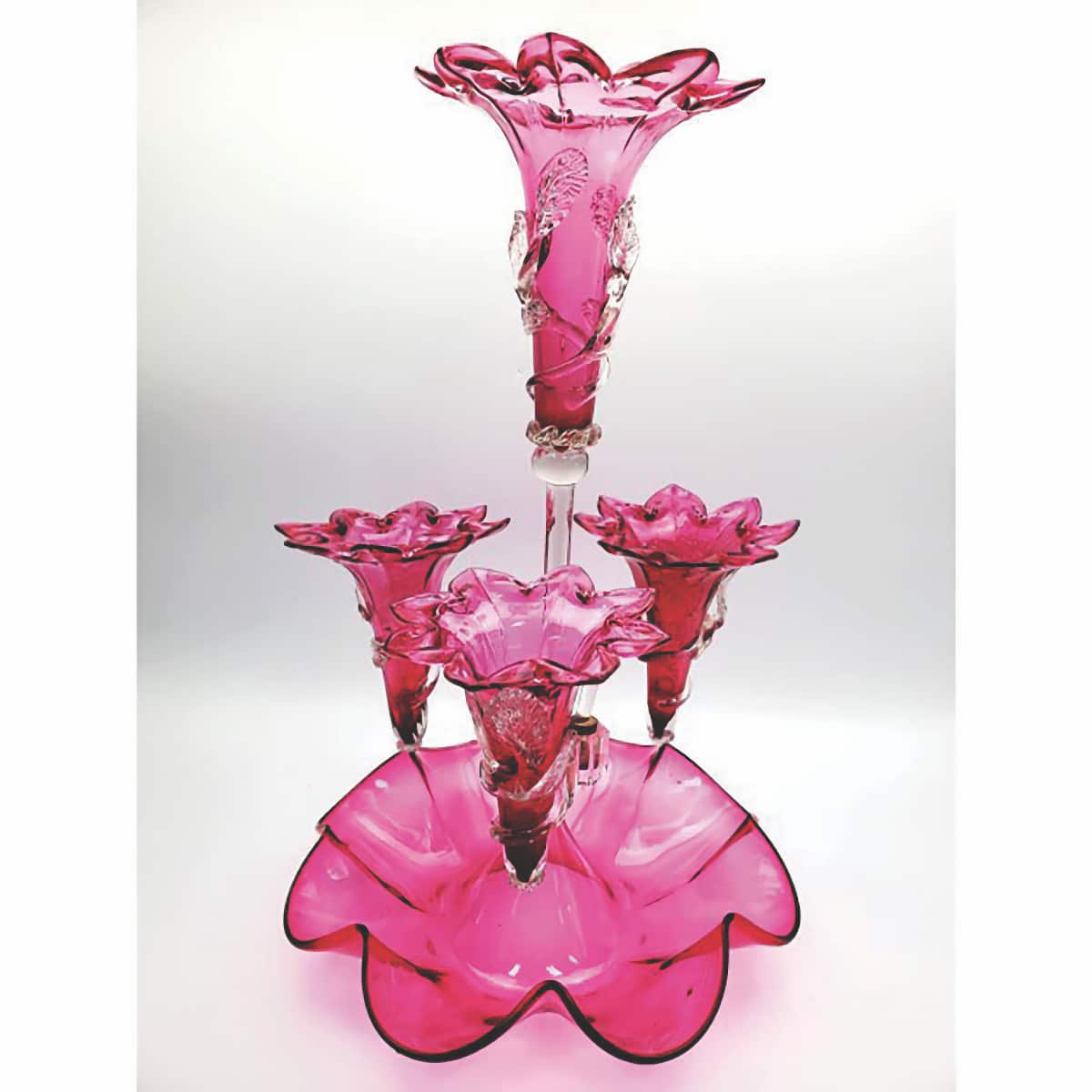
A cranberry glass centerpiece like this one adds a beautiful Victorian touch to a dinner table but wouldn't be practical for serving cranberry sauce. PHOTO CREDIT: World Auction Gallery
Cranberry glass was made into decorative art glass pieces, like this centerpiece with multiple flared flutes and applied leafy trim, which sold for $250 at World Auction Gallery.
This glass color was first made about the time of the Civil War; coincidentally, about the time Thanksgiving became the annual holiday we observe today. Cranberries, a native plant of North America, were a well-established part of the American diet by then. Native Americans enjoyed their astringent flavor and many health benefits, including an abundance of vitamins and disease-treating properties. Historians recorded that they made the berries into a sauce to accompany meat. English colonists quickly adapted them for the same reasons, calling the plant "craneberry" because the curving branches reminded them of cranes' long, thin necks.
English naturalist John Josselyn wrote in his important 1671 work New England's Rarities, discovered in Birds, Beasts, Fishes, Serpents and Plants of that Country that they help prevent scurvy (we now know that one cup of raw cranberries has 25% of the daily recommended value of vitamin C) and are good as a sweetened sauce or in tarts. The first American cookbook, "American Cookery" by Amelia Simmons, published in 1796, encouraged serving cranberry sauce with turkey. Some things never change!
Q: I have an old print of a scene with wild game on a table. I looked it up and found out it was a copy of a painting by Joseph Jambor from 1921. How can I find out if it is worth anything?
A: Joseph (sometimes spelled Josef) Jambor was a Czech artist who lived from about 1887 to 1964. He is known for oil on canvas paintings of landscapes and still lifes. Most of his paintings date to the 1920s or later, so your print cannot have been made before then. There is a Josef Jambor Society in the Czech Republic (josefjambor.cz) that may have more information about the painting. Check your print for any information like the type of print, copyright dates or the name of the printmaker or publisher. An art museum or library in your area may have online or print references to help you. Without further identifying information, your print is probably worth under $50.
TIP: Cranberry juice will stain stone, so be careful if you have marble-top tables. Other liquids will stain, but cranberry juice stains are especially bad.
CURRENT PRICES
Sewing, pin cushion, figural, bird, perching, holding berries in beak, articulated wings, red, glass beads, date on tail, Iroquois, 1903, $75.
Jewelry, bolo tie, figural charm, bird, stylized, inlaid beak, feathers and wings, turquoise, red, black, white, Zuni, 19 inches, charm 2 inches, $150.
Candy container, turkey, standing, wings down, tail fanned, painted, iridescent green, blue head, red, brown, white, papier-mache, Germany, 1920s, 8 1/2 inches, $325.
For more collecting news, tips and resources, visit www.Kovels.com
(c) 2026 King Features Synd., Inc.