
Two large reactors in the northwest, two SMRs in the southeast: Moe lays out Saskatchewan's nuclear plans
By Brian Zinchuk
SASKATOON – Saskatchewan's plans for nuclear power generation became a lot more focused on Sept. 29, clarifying how many megawatts are sought, how many reactors, and in one case, specifically where the first two are expected to be built.
Premier Scott Moe made the announcement in a chemical engineering lab at the University of Saskatchewan, packed with over 80 people from industry, First Nations, labour and municipalities. The setting was deliberate, according to Crown Investments Corp. Minister Jeremy Harrison, highlighting the need to build a nuclear workforce.
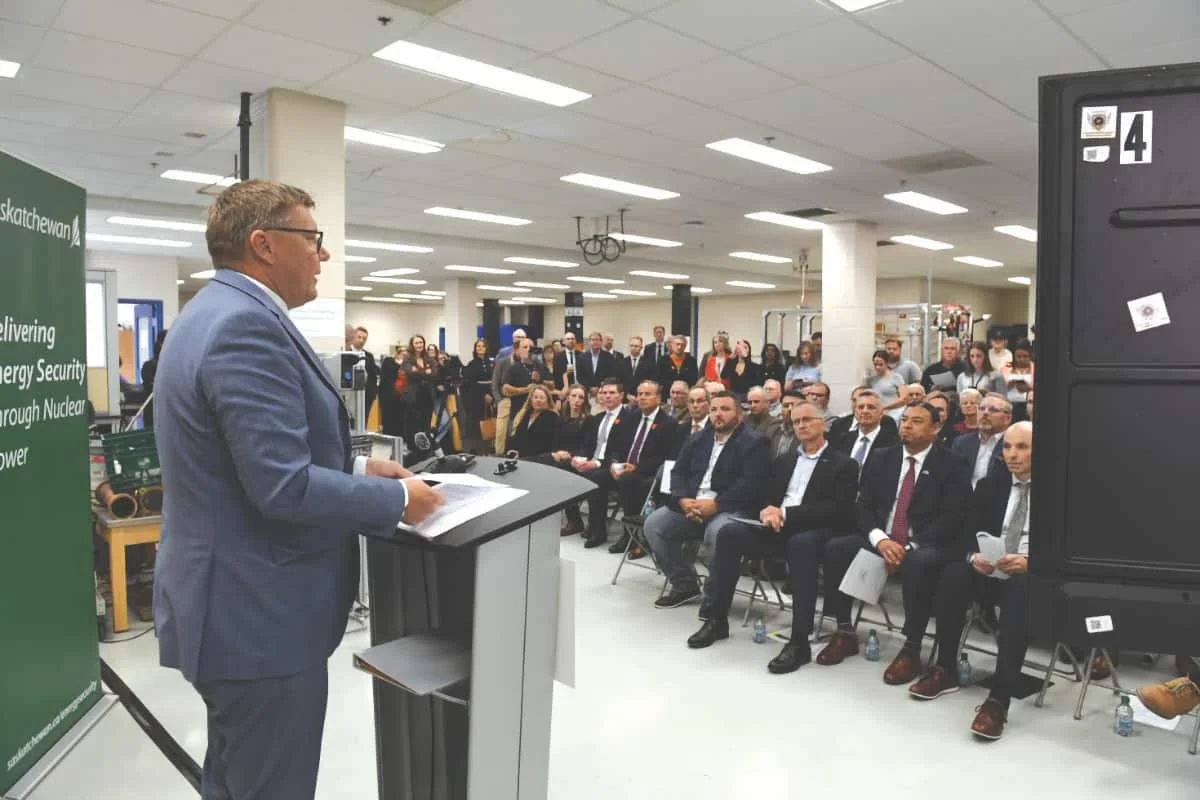
Ready to go nuclear. Premier Scott Moe announces Saskatchewan's nuclear power plans to over 80 people in a chemical engineering lab at the University of Saskatchewan on Sept. 29. The province plans two SMRs near Estevan and two large reactors in the northwest. PHOTO BY BRIAN ZINCHUK
The updated plan outlines that Saskatchewan will be seeking to develop 2,600 megawatts of nuclear power generation from four reactors. Two small modular reactors (SMRs) of 300 megawatts each will be built near Estevan, and two large reactors of the 1,000-megawatt scale in northwest Saskatchewan. That's four reactors planned for a province that has never built one before.
For context, 2,600 megawatts is roughly how much power the entire province uses on a low-demand day in the spring or fall, with winter peaks often around 3,600. But demand is broadly expected to double in the next few decades, which is why Moe referenced an "all of the above" approach.
SMR site finalized
Site selection for the Estevan-area SMRs has been finalized. They will go to the "Rafferty site," due south of Macoun on the north shore of the Rafferty Reservoir. This ends several years of site selection and ends consideration of Boundary Dam Reservoir.
Perhaps most significantly, Rafferty Reservoir has a much more substantial water supply. Seventy kilometres upstream of Boundary Dam, you can literally step across the inches-deep Long Creek that feeds it. At a similar distance upstream of its dam, Rafferty is around 350 metres wide.
The Rafferty site also has very few neighbours, dramatically reducing possible not-in-my-backyard issues. Its proximity to the CPKC mainline, Highway 39 and existing transmission infrastructure stood in its favour. SaskPower bought the land in the summer of 2025. Next comes two years of detailed environmental, safety, cultural and technical studies.
One thing not refined was the timeline. SaskPower had previously aimed for a 2029 decision to build, construction in 2030 and first power in 2034. The new document does not lay out that timeline.
Large reactors
If SMRs are Saskatchewan's appetizers into nuclear power generation, large reactors are the main course. Each will produce over three times the power of an SMR. The leading contenders are the AtkinsRéalis CANDU MONARK, at 950 megawatts per unit, and the Westinghouse AP1000, at 1,100 megawatts.
The goal is over 2,000 megawatts from large reactors, with potential first power by 2042. SaskPower has acquired siting data from Bruce Power, which looked at locations on the North Saskatchewan River in the Lloydminster region as far back as 2008. That preliminary work is now being dusted off.
The government's own document shows how aggressive that timeline is. It notes Bruce Power, an established nuclear operator expanding an existing Ontario facility, submitted its initial project description in 2024 and expects first power in the early-to-mid 2040s.
Pipeline Online asked whether that means Saskatchewan needs to make its investment decision and pick a site almost immediately.
"You are correct, by historical factors ... that there would have to be decision points made fairly quickly with respect to the technology, the site, all of those items," Moe said, adding changing federal legislation could alter the traditional timeline. "This is going to be a strong, steady process."
Harrison said he recently met with the president of the Canadian Nuclear Safety Commission and is "very comfortable" 2042 is a realistic time frame. He also left the door open to large reactors "not just the northwest but the southeast as well.”
Cost?
Several reporters asked about cost and were not given hard answers.
For comparison, in 2025 Ontario Power Generation proceeded with its four-unit Darlington SMR project, the same BWRX-300 design chosen for Rafferty, at a cost of $21 billion. As the world's first BWRX-300s, they carry higher first-of-a-kind costs. And the day after Moe's announcement, the U.S. announced a US$120 billion initiative with South Korea for up to eight large reactors, averaging US$15 billion per unit including contingency.
Moe said there are no dollar figures yet because "we are a while away from actually making that investment." Asked about ownership, he said, "It'd be billions," and that all options are on the table, from full SaskPower ownership to private power purchase agreements.
Asked how SaskPower could absorb the cost without drastic rate hikes, Harrison pointed to the Sizewell C project in the U.K., where a Canadian pension fund is a 20 per cent owner.
"I wouldn't take it as given that there is a day one outlay from governments for the full capital cost," he said.
Article edited down for length. Used with permission.