
St. Paul’s United Church: ’Ti’s the Season … or is it?
By The Rev. Piotr (Peter) Strzelecki VDM
St. Paul’s United Church
I knew a Roman-Catholic priest once, who had an interesting, if not peculiar, habit. Every year, he would spend most of the Boxing Day writing Christmas cards to his family and friends. Most of us would have all the cards written, licked and mailed long before. We would also have quite a few of those displayed on the mantelpiece (if you have one) or somehow stuck onto the refrigerator.
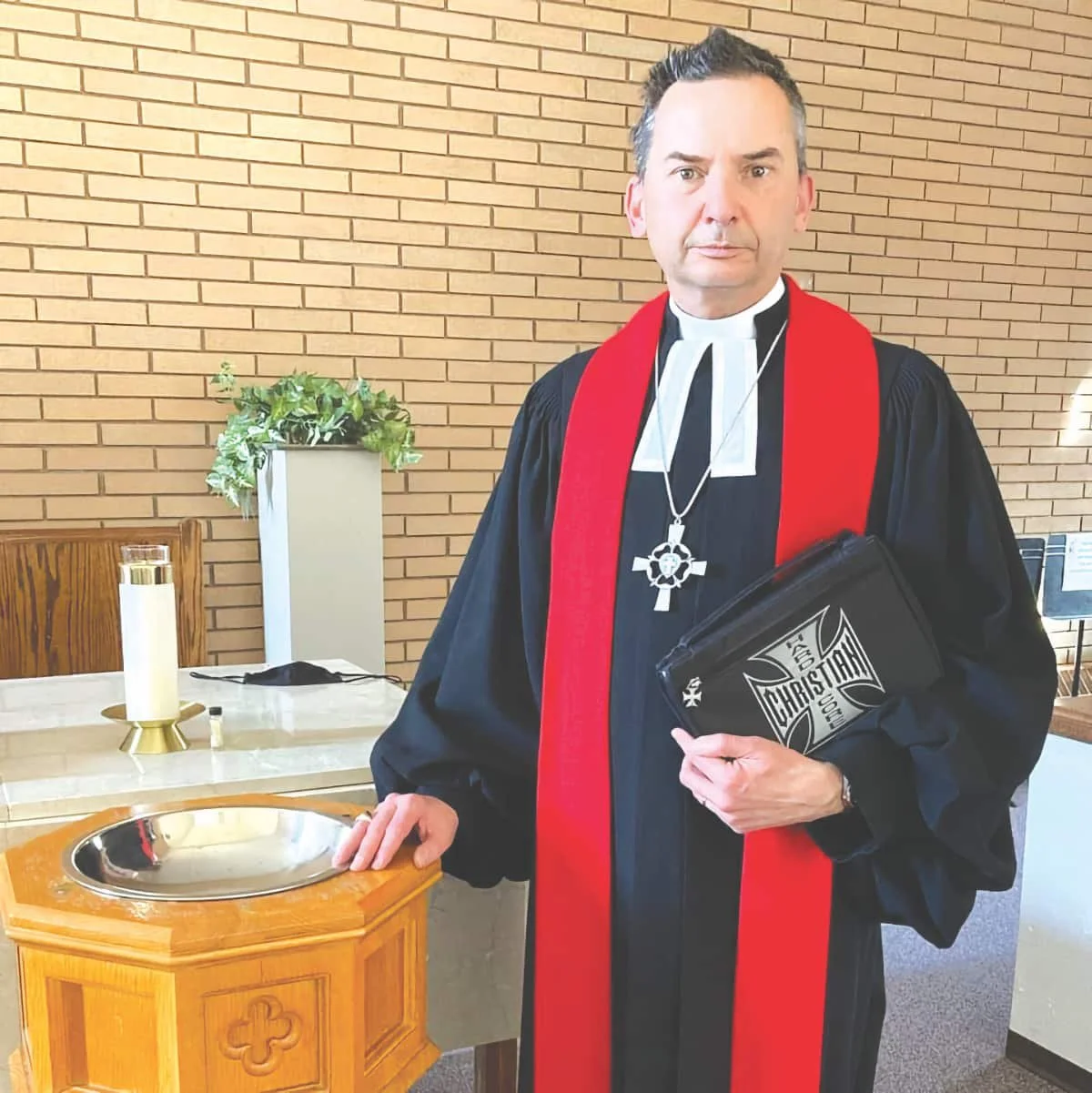
The Rev. Piotr (Peter) Strzelecki
His explanation was that you wish people a Merry (or Happy) Christmas when it actually comes. After all, he used to say, while you may offer someone a belated birthday wishes, you will hardly do so couple for weeks, if not a month, ahead of time. All I could ever say in response was: ‘well … yeah … but … ughhhh … it’s tradition.” Except … it wasn’t always so.
Until commercialisation, and impatience, took over our lives, Christmas season began on Christmas Eve (with Boxing Day in many cultures rightly called “the Second Day of Christmas”). Within a Christian context, a time preceding that was called Advent. A period of waiting, period of preparation, period of reflection on that mystery of faith that we relive every year – that God has chosen to be revealed to us in Jesus, in a king of a unique kingdom born in the barn. Christians would fast, do acts of penance, or engage in themed daily devotions.
Somewhere in the 16th century the Advent wreath began to appear, taking its final shape around 1839.
Then … commerce, opportunity and greed came along. Playing on our ever growing lack of patience and need for instant gratification (just think of the very name “instant coffee” or microwave dinner). Now, if you are extremely unlucky, you can easily spot various Santas, three ornaments or house decorations by end of October. While we celebrate Christmas before Christmas, we cannot wait for Santa’s presents either. Which is why we buy Advent calendars with a gift for every day … chocolate, whisky, mini toys. If you can think it, you can probably buy it. I guess we think of it as something to ease the seemingly unbearable torment of that countdown.
So, what, or who, are we actually waiting for … again. What faith tradition, which story with its theological interpretation, which custom and values are we revisiting and being reminded, on this annual basis.
Well, here is my take and suggestion this time round. We prepare ourselves for having our assumptions, and hopes, challenged. Just like the people in Judea some 2000 years ago. It was time of imperial Roman domination. Religious authorities were largely “in bed” with the occupying authorities. Religion itself was cut-and-dry, black-and-white set of rules and precepts, with punishments clearly laid out. When people heard words like “king” or “kingdom” there thinking of, and hoping for, an army that would overthrow the rulers, that would set new order in place … where they would be the governing class.
The challenge to that vision comes in Jesus who advocated forgiveness, turning the other cheek and looking after the needy regardless of their status, or cultural and religious affiliation. And that challenge begins with the way that king appears amid our humanity. As a vulnerable baby, born in the filth of a barn. The news of his birth was heralded not in the halls of the mighty but at the pasture, to the shepherds. His conception, in the eyes of his contemporaries was also rather unorthodox.
The way we see God affects the way we see the realm of God’s kingdom and kin-dom. The way we see the birth of Jesus affects our understanding of him and of his message. Jesus’ contemporaries looked at him through the lens of their needs, frustrations and hopes. And they ended up disappointed. American theologian and ethicist, Stanley Hauerwas, said once that: “most American Christians don’t know how to read the Bible well, and they don’t know how to read the Bible well, because they’re Americans before they’re Christians.” So how do we hear the Christmas story and message? Who are we first as a person receiving it? Are we Christians first? Canadians? Atheists? Persons of another faith? Does our political affiliation, or economic principles, affect our hearing and reading of it?
In my opinion, if you we are not somehow feeling challenged in our perceptions, if we are not somehow feeling uncomfortable, then we are not reading and hearing that story well. The way it ought to be read and heard and understood.
So, for this time of Advent waiting, and for this upcoming season of Christmas, I hope for all of us, that we may hear in our hearts the voice of the angels proclaiming: “Glory to God in the highest heaven, and on earth peace among those whom he favours” (Luke 2:14). And may this message take root, and may it inform our whole being. May we become God’s agents of peace.