
Mystery of McMorran Coulee
By Gary Johnson
The abandoned and removed CPR line that became known as the McMorran subdivision ran from Milden to McMorran. West of McMorran was a wide coulee, and local lore said the line ended because they could not cross the coulee. That seems unlikely, as CPR would have been aware of the coulee and their ability to cross it long before the rail got to McMorran. Is there another reason?
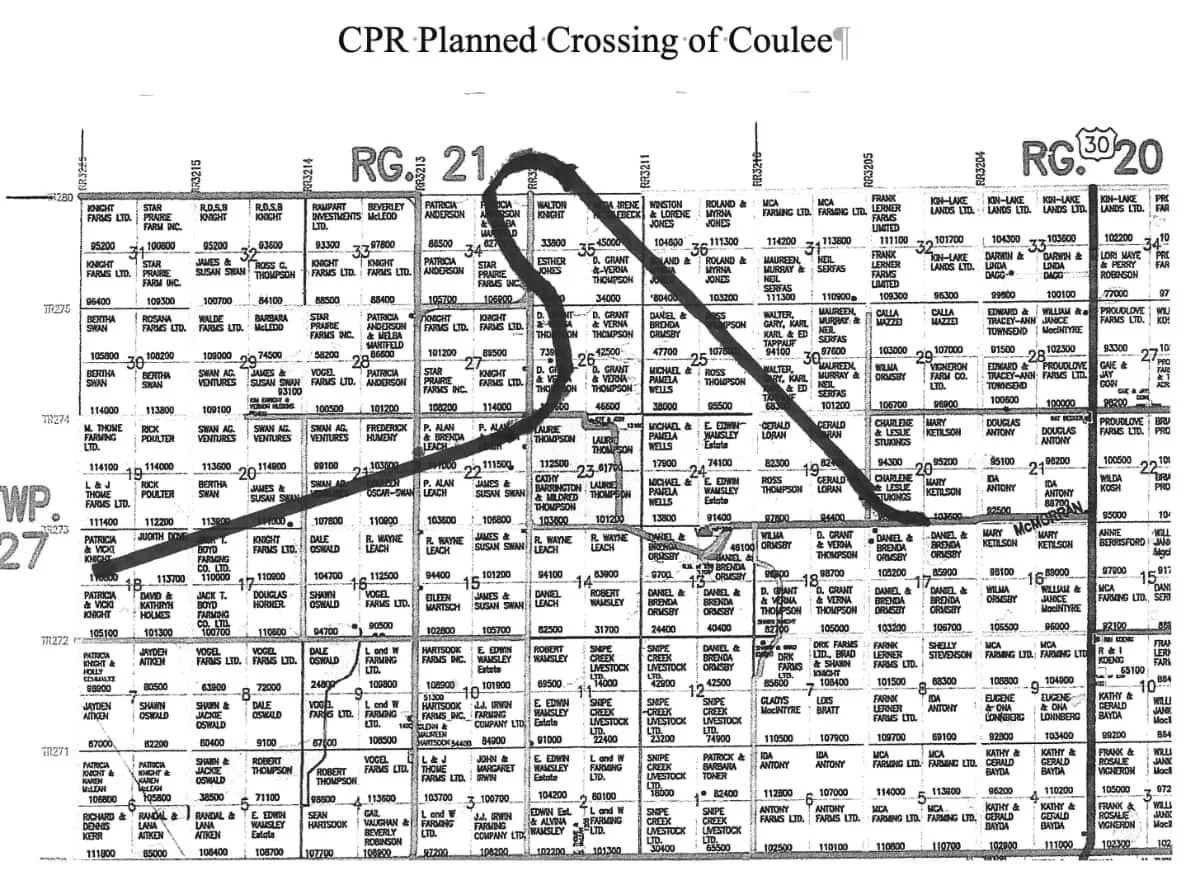
Crossing that never came. The heavy black line traces CPR’s planned 1919 route out of McMorran. It runs north up the east side of the coulee, crosses near today’s Netherhill Road and heads southwest toward Glidden. MAP SUBMITTED BY GARY JOHNSON
The Canadian Archives and CPR Annual Reports help tell the story. The McMorran subdivision was the start of the planned Bassano-Empress-Milden subdivision of CPR, approved in 1913. The line was to begin at Empress, which CPR originally planned to be a major rail terminal, with lines going east, west, north and south. This line was to join the CPR at Milden, between Outlook and Rosetown. One of the reasons given in railroad files was to ship coal from Drumheller, and the heavier than normal steel in the portion that was built supports that purpose. There is local lore at Empress that the railroad could not cross the river and that it was never a real plan. The bridges around Empress, both the CPR bridges and the highway bridge, show that crossing the river would not have been an insurmountable issue, and construction to McMorran shows there was a plan.
From CPR blueprints, the approved route began at Milden and went west to McMorran and then headed southwest to Glidden. The line was to cross under the CNR east of Glidden and then proceed in a southwest direction to about six miles south of Eatonia. It was then to head west for 10 miles to the Cabri Lake Hills, where it would turn south to the South Saskatchewan River across from Westerham and follow the river west into Empress.
The 1913 documents show many approved routes in the same area. A CNR line from Shackleton crosses the South Saskatchewan, and then one branch heads to Elrose and the other to Beadle, passing by Eston on the way. The Alberta Central Railroad was to go from Alsask to Glidden, then to Eston and southwest to a river crossing south of Elbow.
According to the CPR Annual Report, construction of the Bassano-Empress-Milden line was approved by the Board of Directors in 1918, based on an approved route from 1913, at a total of 132 miles. Also approved was the Acme to Empress line. The Acme line would pass through Drumheller on its way to Duchess and then Empress. Coal from Drumheller could then be shipped east from Empress.
The Board acknowledged at that time that construction would proceed slowly due to the shortage of labour and equipment.
The CPR construction blueprints in 1919 show that the line was planned from McMorran to follow the coulee about six miles north along the east side, and then cross the coulee in 3-28-21 in what is now the RM of Kindersley (in the vicinity of today’s Netherhill Road). It would then proceed south to 23-27-21 and then southwest on the east side of Cutbank Lake to Glidden. A detailed survey was completed by CPR, and landowners were identified and contacted from McMorran to Glidden.
Considerable communication is available in the archive showing concern from residents of Glidden and the R.M. of Newcombe that the line would be south of the townsite of Glidden and that the route west was not far enough south. The lobby began in 1919 and continued to at least 1925. The Eatonia Board of Trade suggested joint running rights from Glidden to Laporte.
In the end, after a public hearing, CPR stayed with its original plan and waited for authorization to proceed with more construction.
CPR focused its construction from 1925 to 1929 on the Prince Albert and Swift Current areas, with little construction in the 1930s. There was never any further work past McMorran and the 66 miles constructed. CPR expansion in Saskatchewan was greatly reduced from 1925 onward.
Was there a market for coal that CNR got to first? Did markets for railroad services decline? Was it too close to the CNR? Did the grand plan for Empress end? The Duff Commission in 1931-32 reported on the financial difficulties railroads were in at that time. It highlighted overdevelopment of lines where there was no viable need, aggressive competition between companies to service areas, revenues that would not support many of the existing lines, and the potential future reduction in railroad volumes due to increasing highway use. The Commission suggested some lines might have to be closed and others operate only on a seasonal basis. It seems that economic reality, not a coulee, saw the CPR line end at McMorran.
Supporting documentation includes the Canadian Archives files on the CPR Bassano-Empress-Milden line, including maps, listings of lands and owners, and letters and replies from various sources. CPR Annual Reports are available online.