
Fred Fox shares brother Terry’s legacy with west-central students
By Ian MacKay
People around the world still honour a man who ran halfway across Canada more than 45 years ago.
Fred Fox told students in west-central Saskatchewan last week about the boy and man who was his brother, Terry Fox.
Terry Fox began his Marathon of Hope to raise money to find a cure for cancer in April 1980, starting by dipping the foot of his artificial leg into Atlantic Ocean waters off St. John’s, N.L.
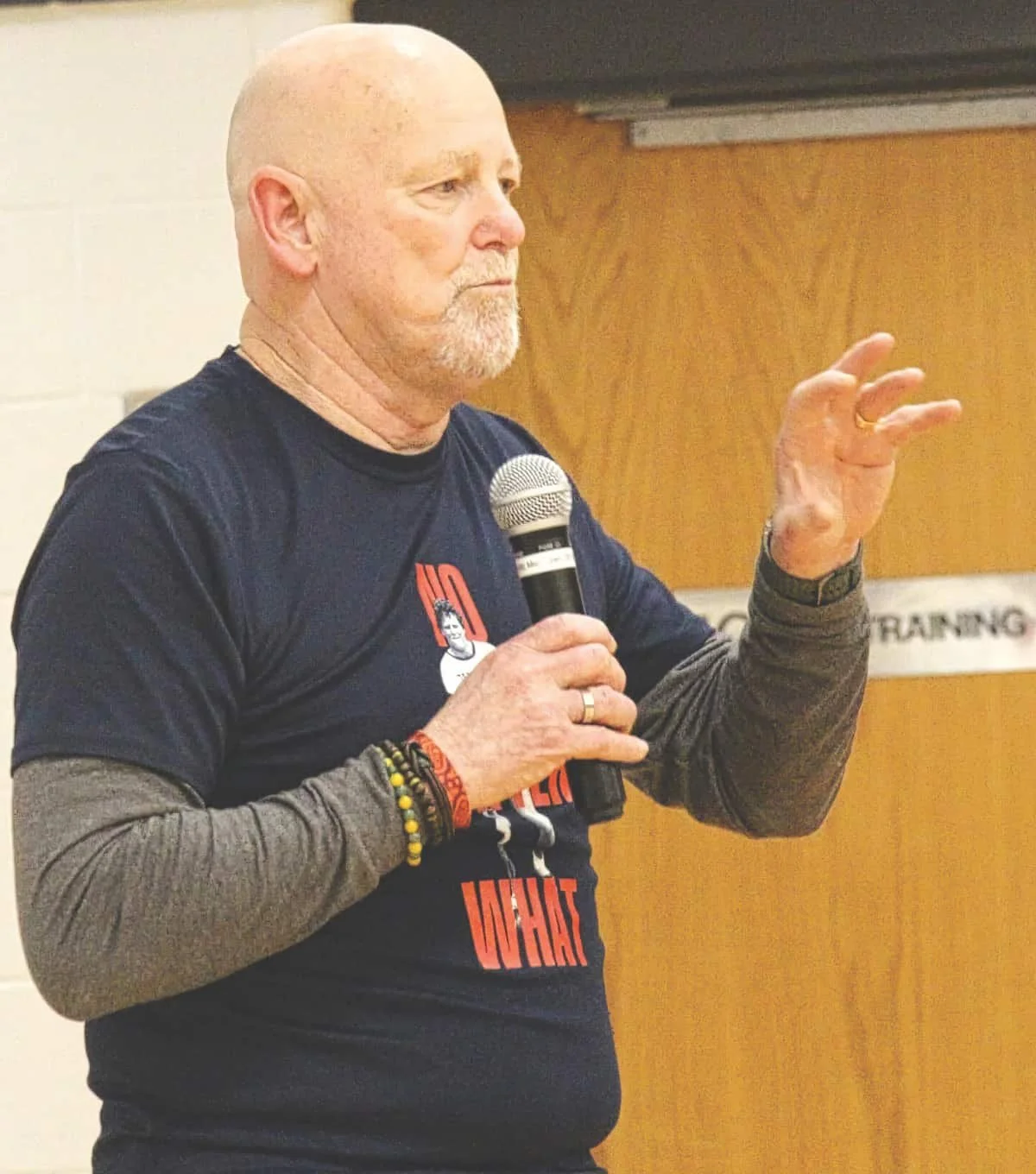
Terry Fox’s older brother Fred Fox begins his talk about Terry’s Marathon of Hope at Rosetown Central High School on Thursday morning, his last stop on a tour of Sun West School Division schools before returning home to Maple Ridge, B.C., for Easter, then visits to Regina and western Manitoba to continue the quest to find cures for cancer. Photo Rosetown High School
He made it to Thunder Bay, Ont., before being forced to quit after the cancer that claimed his right leg had spread to his lungs, Fred Fox said.
“Who gets to talk about their brother all the time? I’m proud of what Terry did in 1980 and how he’s inspired so many people today,” Fred said after his presentation, which included family photos of Terry growing up.
“It’s an opportunity,” he said. “To share that with students who obviously weren’t around back then, it just makes your heart warm.”
Fred, who was about a year older than Terry, speaks around the country for six to eight weeks each spring and fall, “a little bit more the last couple of years internationally as well, sharing Terry’s story at schools and community events,” he said.
“So many schools that I have visited this last four days in the Sun West division have done so much over the years to keep Terry’s dream alive,” Fox told students at Rosetown Central High School on Thursday morning.
The Fox family, born in Manitoba and later moving to the Lower Mainland of British Columbia, learned Terry had to stop his cross-Canada run after turning on the car radio following “a big fundraiser” at CFB Chilliwack, he said.
Terry started his journey of running the marathon distance, about 42 kilometres each day, with little public recognition, aiming to raise $1 million, Fox said. Then he raised $10,000, a dollar per resident, at Port aux Basques, where his team took their camper by ferry to Cape Breton, Nova Scotia, Fox said.
By the time he reached Ontario, “all of Canada” knew about the journey, Fox said. He did a ceremonial kickoff at a football game in Ottawa between the hometown Rough Riders and the Saskatchewan Roughriders and, in Toronto, ran with Toronto Maple Leafs captain Daryl Sittler, as well as Fred himself, to city hall, with “thousands of people lining the streets, cheering Terry on,” Fox recalled.
“It was amazing to run with Terry, seeing the commitment, the dedication, the focus on every step that he took,” he said.
As a boy, Terry remained determined to finish what he started, he said, telling students that his mother recalled him stacking blocks over and over until they didn’t fall down.
He was short but athletic and wanted to play basketball when he started junior high school in Port Coquitlam. His coach told him he was improving with every practice but wouldn’t see much action that first year.
He worked on shooting baskets every day at noon hour and elsewhere in the city on weekends and was one of the starters and the team captain in his senior year, Fox said.
“That came out of hard work and determination,” he said.
Terry made the junior varsity team as a freshman at Simon Fraser University. Coaches later told their parents they couldn’t cut him, Fox said. With players on scholarships from across the country, “Terry made them better,” he said.
He played other sports and eventually sought medical attention for a sore knee, probably from a rugby hit, Terry thought.
“He probably should have gone to see a doctor a lot sooner than he did,” Fox said. One day, he couldn’t stand due to the pain. X-rays showed a type of sarcoma in the knee and Terry learned he would have to “lose part of his right leg, three inches above his knee,” Fox said.
“He was devastated,” and the rest of the family was “in shock,” but it meant “another challenge I’d have to overcome,” Fox recalled him saying. “Ten days later, he was fitted with an artificial leg, needing to learn how to walk all over again at 18.”
Later, receiving chemotherapy and seeing other people young and old fighting their cancers “changed Terry’s life,” he said.
Eventually, he started running at night so people wouldn’t see him fall down, Fox said.
“Learning how to walk on an artificial leg is hard; trying to figure out how to run on an artificial leg made for walking is way harder,” he said.
By Terry’s 21st birthday, he “was running 15, 20 kilometres every day,” he said. Telling his family he was training for the Vancouver marathon, he went to Prince George for a 27-kilometre race. “The only amputee” finished last but met his goal of finishing.
“Two days later,” Terry told his mother that he actually wanted to run across Canada “to raise money for cancer research so no one else in the future will ever have to suffer from a cancer diagnosis,” Fox said.
After being forced to stop near Thunder Bay, he returned home to Port Coquitlam, where the family received “40,000 pieces of mail” and former governor general Ed Schreyer presented him with the Companion of the Order of Canada.
“Terry truly believed that he’d get back out there and finish his run, that his health would get better . . . but he got weaker, he got sicker” and died nine months after he had to stop.
The Terry Fox Run has taken place at Walter Aseltine School for the past 20 years, Fox had learned. The annual run occurs at 10,000 schools in Canada and in “34 countries that are keeping Terry’s dream alive,” he said.
“Terry was just an ordinary, average Canadian kid” who “had to work harder than everyone else,” he said.
“Terry showed us in 1980, when he was running across Canada, one person can make a difference,” Fox said, telling students, “You can make a difference. Terry truly believed that anything is possible if you try.”