
Call it Energy East 2.0, but kinda sorta, not really
By Brian Zinchuk
www.pipelineonline.ca
CALGARY – Two years ago at the Lloydminster Heavy Oil Show, Alberta Premier Danielle Smith spoke of new export pipelines in several directions, most likely following existing rights-of-way as opposed to new ones. On July 6, she announced the third such project, along with Ontario Premier Doug Ford.
The entire purpose of these pipelines is to accommodate the doubling of Alberta oil production.
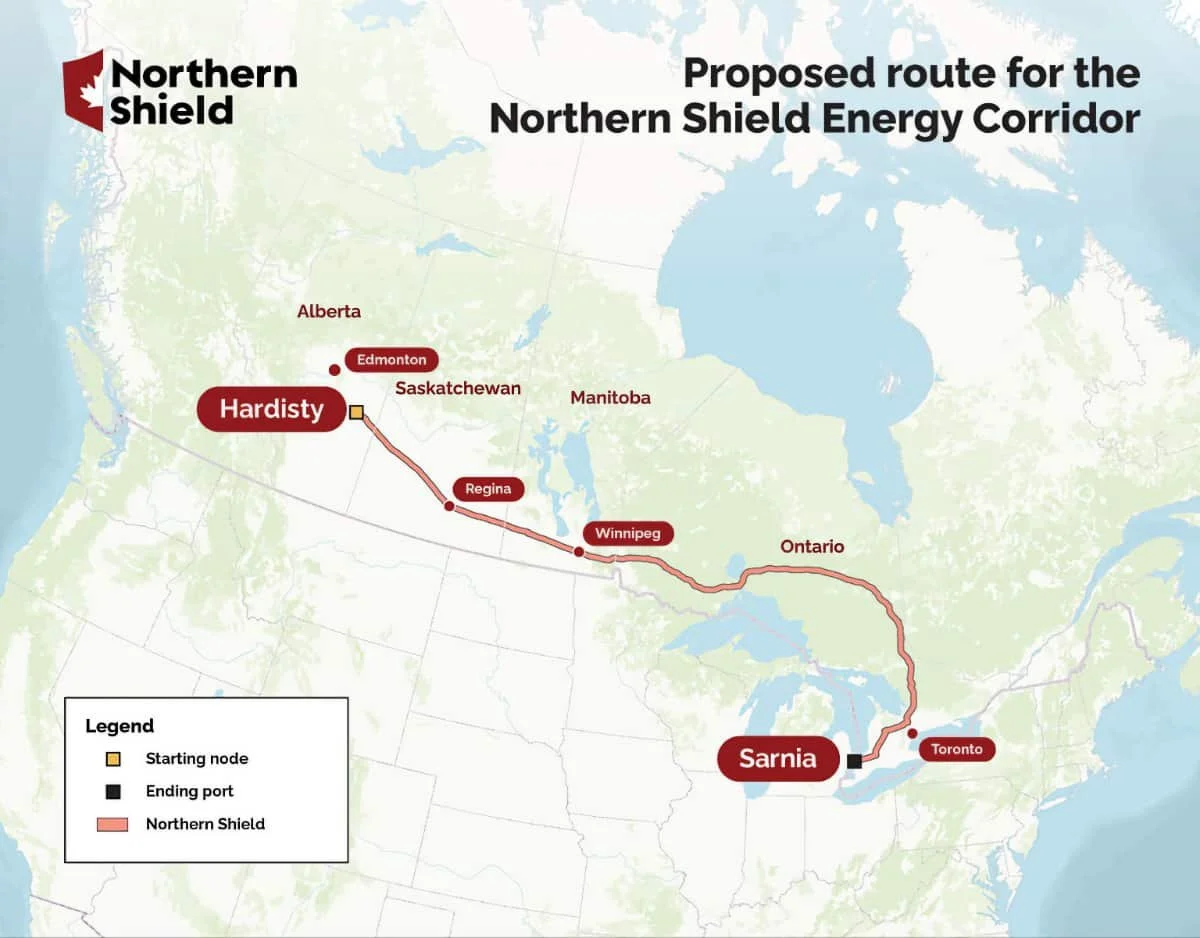
The latest announcement, less than a week after an announcement of a new West Coast Pipeline project, heads east, with the purpose of servicing the Ontario market. While not discussed in the press release, Michigan has been working for years towards trying to shut down Enbridge's Line 5 across the Strait of Mackinac, before any potential catastrophic pipeline failure could occur along the lake bottom of the Great Lakes. If Michigan ever does succeed in shutting down Line 5, Ontario could literally find itself freezing in the dark.
This new proposal, still very much in early stages as a feasibility study, is called the Northern Shield Energy Corridor. Its map shows that much of it is essentially a revival of the defunct Energy East Pipeline project, but with several differences.
First of all, Energy East was proposed by then-TransCanada Pipeline. This new one is a multi-government proposal.
Energy East would have originated from Hardisty, gone to Empress, Alberta, and made use of repurposing an existing, underused pipeline within the TransCanada Mainline system. It would have spanned the country, all the way to the Irving Refinery in New Brunswick. And Energy East was expected to transport up to 1.1 million barrels per day. This proposed pipeline is pegged at 500,000 barrels per day, with capacity of expansion of up to 800,000 bpd.
There was no mention of repurposing an existing pipeline. The map indicates that this new pipeline would likely parallel the existing Enbridge Mainline from Hardisty to Regina. From Regina it would parallel the now-TC Energy Mainline into eastern Ontario. But the big difference is that instead of heading east into Quebec, it would hook southwest to Sarnia.
And there, not only would it supply the Sarnia refinery and petrochemical complex, it would also potentially supply a new strategic petroleum reserve, something Canada is notably lacking. Ford mentioned not only existing and potentially expanded refineries, but even new ones. There has not been a new, greenfield major refinery built in Canada in decades.
There were also allusions to reaching tidewater for international export. At this time last year noises were made about the possibility of building an export terminal at the very southern tip of James Bay, most likely at Moosonee. There's a big problem with that, however. There is no deep water on the Ontario shores of James Bay, at least not deep enough for large cargo ships like oil tankers. But the proposed new pipeline would come within 275 kilometres of Moosonee, following an existing railbed. And, with an enormous amount of dredging, it could accommodate oil tankers, at least the smaller ones.
There was even mention of possibly building a lateral to Churchill, Manitoba, although notably Manitoba Premier Wab Kinew was not part of the announcement. Saskatchewan Premier Scott Moe was acknowledged but not present. Moe had previously made known that all pipeline projects going through Saskatchewan should be considered pre-approved.
With reference to Saskatchewan, there is a very notable change compared to the Energy East plan. A significant part of that project would have been an on-ramp for Saskatchewan and Manitoba oil to join the pipeline at Moosomin. A 71 kilometre Cromer Lateral was planned to connect the Enbridge mainline terminal to Moosomin. With major developments underway with the Enbridge Line 26 reversal, the prospects of a new Cromer Lateral are unlikely. (Pipeline Online is working on a major story in this regard – watch for it.)
So this new incarnation will most likely see the pipeline simply pass through Saskatchewan, although there could be the possibility of Saskatchewan oil joining it at Hardisty, the pipeline's kickoff. It all depends on what grades of product this proposed pipeline will carry, be it a consistent heavy oil, or a batched pipeline like the current Enbridge Line 5, which carries everything from light oil to propane.
Ford's talk of a strategic petroleum reserve would be a major development for Canada. The attitude until recently has been that an SPR was unnecessary, as we could supply our own needs. But since parts of Central and Eastern Canada rely on imports, and disruptions like the Iran War can impact said imports, an SPR could smooth out any disruptions.
Northern Shield Energy Corridor
At the press conference, Smith said, "I have also said many times that Alberta's aim is to double our oil production in the next 10 to 15 years, and to diversify our export markets. And that means not only reaching global customers, but ensuring Canadians can benefit from our resources here at home. Alberta is ready to provide that stability and be the heart of a more energy sovereign and economically resilient Canada.
"The government of Ontario is here today to unveil a potential route for a new 3,300 kilometre oil pipeline from Hardisty, Alberta to Sarnia, Ontario, known as the Northern Shield Energy Corridor. This project would pave the way for Alberta's barrier-free access to domestic refineries and markets in Eastern Canada. A new East-West pipeline would move an additional 500,000 barrels of Alberta oil per day, with the potential for a future expansion of up to 800,000 barrels per day.”
Strategic petroleum reserve
Smith continued, "This new corridor will include the concept of a strategic petroleum reserve, or SPR, that will store vital Alberta oil reserves in the Sarnia refinery area to ensure key refined products like diesel, jet fuel, and gasoline are uninterrupted.
"There is also an opportunity to eventually use this corridor to reach the Atlantic Ocean, which would allow Alberta to provide reliable energy to our nation's European allies.
"Now that a potential route has been identified, the Government of Ontario is commencing work to estimate costs and examine commercial models and related development opportunities for the energy corridor."
Smith added, "The Alberta oil sands have gone from a target to a national treasure, and we're launching the greatest expansion of oil and gas infrastructure and production in decades.”
Ontario perspective
Premier Ford said, "The Northern Shield Energy Corridor will include a new pipeline, built using Canadian steel by Canadian workers, that will bring oil from Hardisty, Alberta to new and expanded refineries in Sarnia, Ontario. It would move an estimated half a million barrels of oil per day, with the ability to expand to 800,000 barrels per day, bringing new capacity to Ontario refineries and delivering critical redundancy for existing pipelines.
"While creating good paying jobs for Canadian workers along the entire route, the Northern Shield Energy Corridor will create new opportunities for Indigenous people, including equity partnerships, job training, and community investments.
"It's a win, win, win – a win for Ontario, a win for Alberta, and a win for all of Canada. While today is an exciting milestone, there's still a lot of work ahead of us.
"Ontario will continue to advance its feasibility study, including by exploring new and existing port options for pipeline extensions and a potential strategic petroleum reserve. We've launched and will honor our duty to consult with Indigenous communities.
"This new route will also provide the government of Manitoba and the Manitoba Crown Indigenous Corporation with the opportunity to explore the feasibility of a pipeline extension to the port of Churchill. I look forward to working with Premier Smith and all my premiers to get this done," Ford said.
Questions – who pays?
One reporter asked who was planning to pay for the multi-billion dollar project, private or public.
Ford said, "Well, we'll look at both. That's why we're doing the feasibility study. We'll reach out to private sector, but we won't hesitate to do what the Government in Canada and Alberta is doing. We will have this done by the end of the year, then we'll be able to give you a straighter answer."
Smith said, "The thing to remember about pipelines is they're an excellent investment. Ultimately, who pays for them is the people who use them, the shippers. They pay through tolls. And we've already seen that with the Trans Mountain pipeline. The federal government did front the money, but they're now earning $1.2 billion per year to pay it back. It is a revenue generating business.
"I always hope that we can have private partners come forward on this, because that also allows us to have the market discipline. But I'm grateful that Premier Ford is willing to look at all the options.”
Manitoba prospects to Churchill?
On Manitoba and an arctic gateway, Ford said, "I think the world of Premier Kinew. He has to consult a little more with his folks in Manitoba, but we'll work something out, and I'm 100 per cent behind putting a pipeline up to Churchill and getting ice breakers and start delivering it around the world."
On timelines, Ford said, "We were communicating with 77 Indigenous communities, which play an absolute critical role in this. We've been actually working on this for over the last year, and we have some real experts in the province that put a pipeline route all the way through Ontario from Alberta through Manitoba and Saskatchewan, with the approval of obviously Saskatchewan, Manitoba.
"We're going to go full steam ahead. We have great steel companies in Ontario, and so does Saskatchewan, so does Manitoba. But we have to make sure it's Canadian steel."
Where's all the oil coming from?
Smith was asked how the industry would fill an additional 500,000 to 800,000 barrels a day on top of expansions already announced and a possible West Coast line.
Smith replied, "I've said that we wanted to double oil and gas production over 10 to 15 years. When I made that promise, we were at 3.7 million barrels per day in production. We're at 5 million barrels per day right now. If you look at all of the projects that had at previous points been approved and gone through permitting, but stopped because we didn't have pipeline access, that comes up to about 2 million barrels a day, right there.
"I got that question to Imperial, and they said they have 450,000 in production, they have the capacity to go to 900,000. They launched Black Rod with 37,000 greenfield, and for SAGD, they have the ability to go up to 80,000. I talked to another oil sands producer, they said that they have a 300,000 SAGD could go up to 700,000.
"Remember, we are one of the largest reserves on the planet. We've got 177 billion barrels of recoverable reserves in today's technology. We've got 1.8 trillion barrels of oil in place. We've got to be looking at being one of the top three energy producers and exporters in the world.”
Domestic use or exports?
Asked if the oil would be for domestic use or exports, Ford replied, "We use 400,000 barrels a day, and if we bring in 500,000, hopefully we have some reserve for a rainy day. But wouldn't it be great, folks, that we could bring this pipeline right across the country, right over to Irving? It'd be beautiful for East Coast provinces, and be beautiful for the people of Quebec as well. But that's up to them."
Smith replied, "We already do take oil up the seaway from Line 9 and it gets refined in Quebec. This is an opportunity for us to support Quebec with existing infrastructure, and we'll be looking at whether or not those ships can make it up and over and go to Eastern Canada to feed those refineries, and whether we'd be able to go on to Europe.”
How Sask going nuclear ties in
Asked how the Pathways Alliance carbon capture project ties in, Smith responded that had more to do with the West Coast Pipeline. But she added that one part of the Pathways project was to use best available technology, "and whether that's nuclear or geothermal, that allows us to decarbonize, that's going to be available to any operator once those types of technologies are mature and once we build the intertie between us and Saskatchewan."
This is a clear allusion to Saskatchewan's plans to develop nuclear power generation, and Alberta being a potential buyer of some of that power via the intertie expansion that Smith referenced.
Thanks for the nice, neutral question
Another reporter noted the South Bow Pipeline to the US is fully subscribed for 20 years, while this project has no customers signed up, and asked whether that meant no one in the industry actually believes it will be built.
Smith replied, "Well, thanks for the nice neutral question.
"I would say it's a bit premature to make that point. You can start a pipeline with a smaller amount going through it, and then you can do compression, just like we're seeing with the Trans Mountain pipeline. It's our job to make sure that we can expand the industry by 2 million barrels, so not only can we fill the South Bow line, we can fill the West Coast line, we can fill our new Northern Shield pipeline.
"A few years ago we were talking about projects in all directions, with Northern Gateway, Keystone, and Energy East, and for various reasons they ended up all stalling. So this is resurrecting all three of those concepts, perhaps on different corridors with some different partners, but I feel like the industry was there 10 years ago, they can be there again."
Ford concluded, "The previous federal government treated Alberta like garbage. I know that Premier Smith wants a proud, sovereign Alberta, part of Canada, and we're there to support her. It's Team Canada. I'll do anything we can."
Article edited down for length. Used with permission.