
Alberta, Ottawa set 2027 start for west coast oil pipeline
By Your Southwest Media Group
The governments of Alberta and Canada have agreed on a path to build a new oil pipeline to the west coast, with construction able to begin as early as Sept. 1, 2027.
The agreement, announced May 15, finalizes key parts of the Alberta-Canada energy memorandum of understanding. It builds on the Alberta-Canada Energy Agreement signed in November 2025. The two governments say the deal reduces regulatory uncertainty and creates the conditions for Alberta to increase energy production and exports.
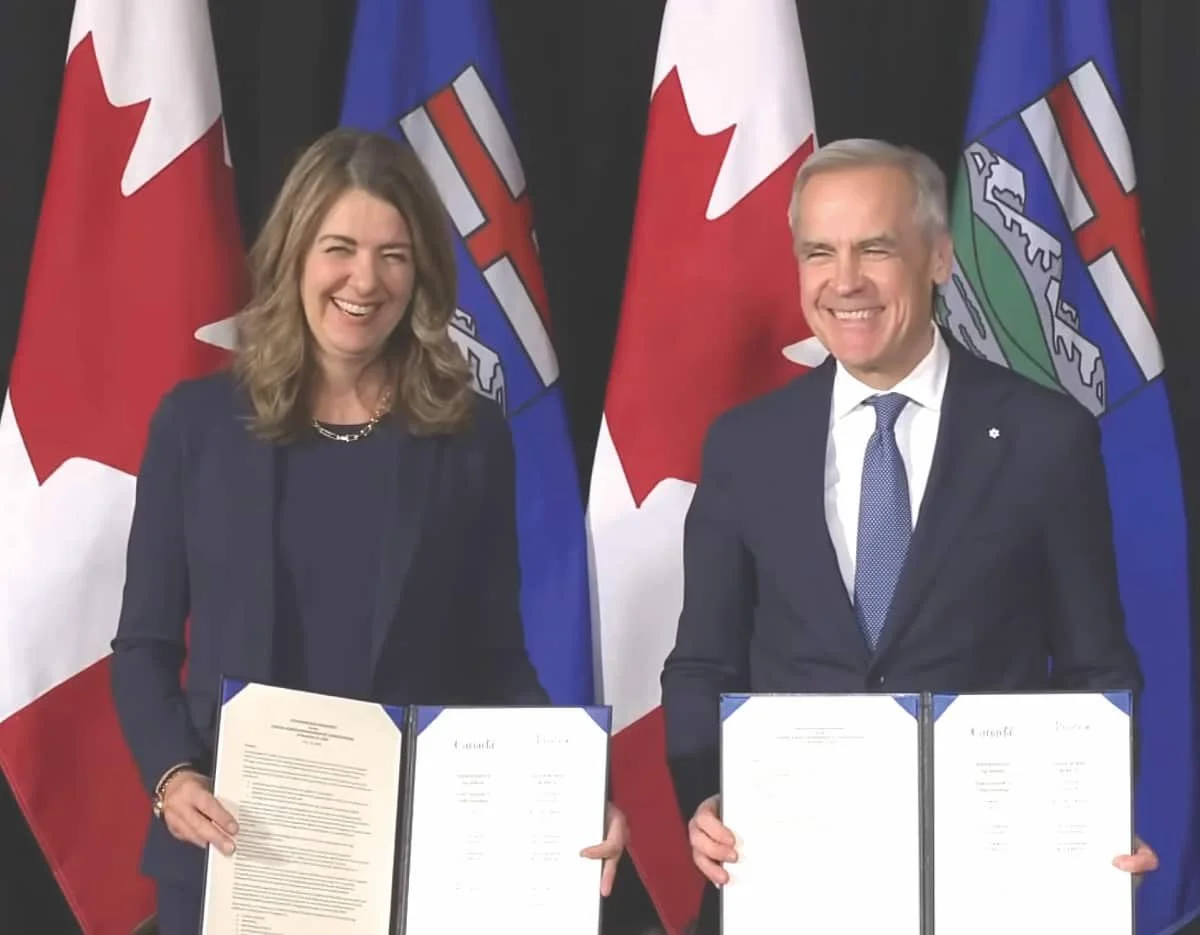
Alberta Premier Danielle Smith and Prime Minister Mark Carney participate in a signing ceremony on Friday, May 15. SCREENSHOT - GOV’T OF ALBERTA
The proposed pipeline would carry more than one million barrels of oil per day to a west coast port for shipment to Asian markets. Both governments describe it as an Indigenous co-owned project. They say it would end the country's reliance on a single customer for its most valuable resource.
Ottawa has committed to a prompt review of Alberta's submission to the federal Major Projects Office. The goal is to have the pipeline designated a project of national interest by Oct. 1, 2026, clearing the way for design and construction to start the following year.
"This agreement sends a clear message to investors and global partners that Canada and Alberta are serious about expanding market access, building major infrastructure and creating the conditions for long-term investment," said Premier Danielle Smith. "Alberta is ready to build, invest and partner, but we cannot afford to lose another decade."
Prime Minister Mark Carney said the deal shows the rules for major projects are clear. "Today's agreement reinforces that Alberta and Canada are lands where the opportunities are plentiful, the rules are clear, and one project means one review," he said.
The governments say the agreement respects Canada's duty to consult Indigenous peoples. They have committed to early and meaningful consultation with First Nations and Métis communities, and to supporting Indigenous ownership and partnership opportunities.
Jim Boucher, former chief of Fort McKay First Nation and co-founder of the Saa Dene Group, welcomed the step. "This project would provide significant economic benefits and long-term prosperity for First Nations," he said. "It is critical that governments continue to engage and work in meaningful partnership with First Nations as this work moves forward."
Dave Lamouche, president of the Metis Settlement General Council, said a project of that scale would drive long-term economic growth and create jobs during construction and operation.
The deal also changes industrial carbon pricing. The previous federal policy would have required a price of $170 per tonne by 2030. Under the new agreement, the price stays at $95 per tonne for the rest of 2026, rises to $100 per tonne from 2027 to 2030, and reaches $130 per tonne by 2035. It then climbs 1.5 per cent per year to 2040.
The agreement applies sector-specific rules for large emitters in the oil, gas and electricity sectors under Alberta's Technology, Innovation and Emissions Reduction system, known as TIER. A price floor will be added in 2030 to reduce volatility and bring predictability to the province's industrial carbon market.
Alberta says the lower carbon price will save its industry partners about $250 billion over the next two decades to 2050.
Deborah Yedlin, president and CEO of the Calgary Chamber of Commerce, said the agreement gives industry the certainty it needs to invest. She said the announcement comes at a pivotal moment for global energy markets.
The agreement is the latest in a series of moves the two governments have made since November. Earlier steps included a commitment not to proceed with a federal oil and gas emissions cap, abeyance of the federal Clean Electricity Regulations in Alberta, and an agreement-in-principle allowing Alberta to keep regulating methane under its own system while cutting emissions 75 per cent from 2014 levels by 2035.
Both governments also remain committed to working with the Oil Sands Alliance, formerly known as Pathways, on a large carbon capture, utilization and storage project. The two sides will also form a joint working group to study low-emission electricity, including nuclear, geothermal, wind, solar and hydrogen.