
Pipeline Online: Turn the lights off in January
BY BRIAN ZINCHUK
www.pipelineonline.ca
If you’re serious, put your Grandma’s old folks home on the prioritized list to turn the lights off in January.
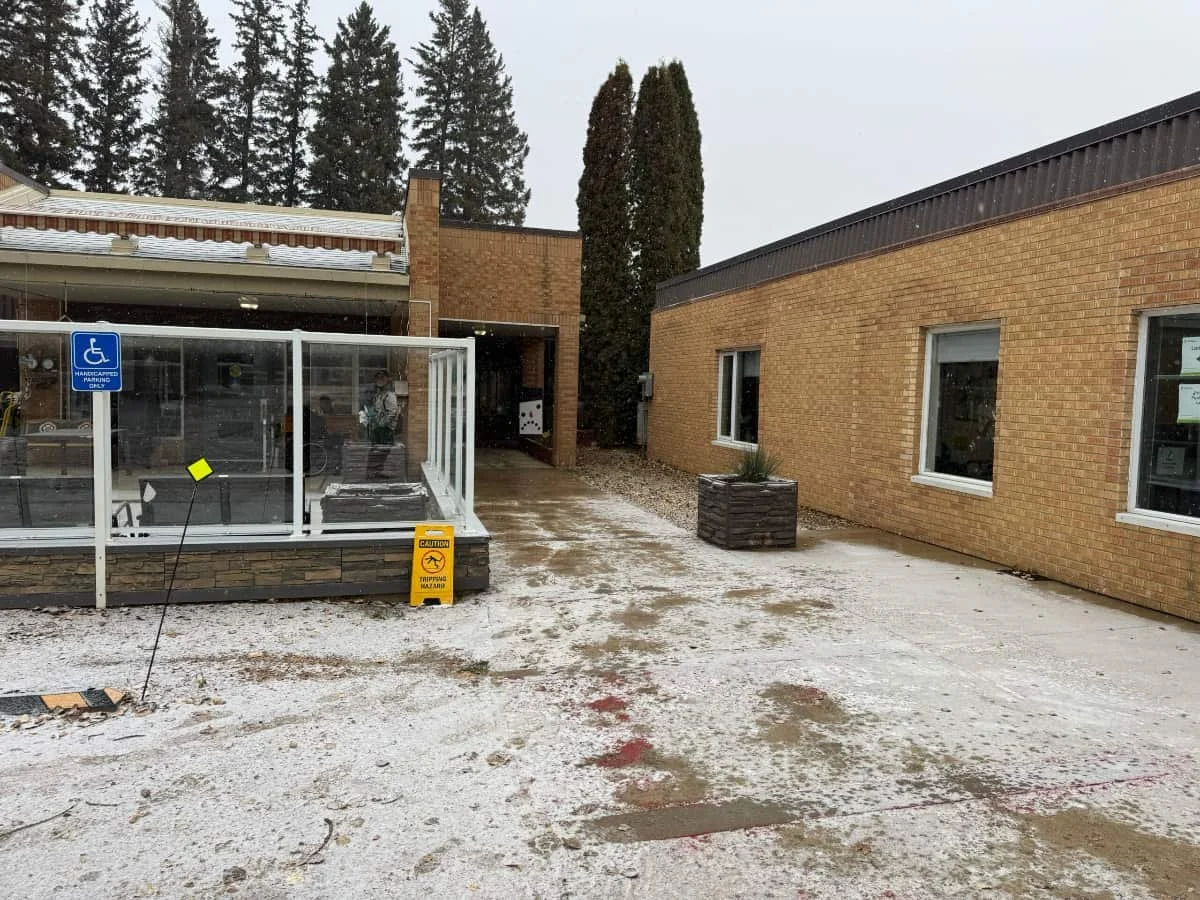
This is the long-term care home in Norquay. Would you put your parents or grandparent’s old folks home on a list to have their power shut off Jan. 1, 2030? Photo by Brian Zinchuk
In all my numerous discussions about Saskatchewan maintaining its coal-fired power fleet until it gets not one, but numerous nuclear reactors online, I’ve come up with a new argument point:
“If you wish to turn off coal, please provide an itemized and prioritized list of which old folks homes, hospitals, schools, factories, apartments and homes we will shut the power off to first on Jan. 1, 2030, which is exactly what would have to happen if we were to follow federal coal legislation. Does your grandma live in an old folks home in Saskatchewan? Please make sure it’s high on the list. Like No. 1.
“Otherwise, wake up.”
Well, that’s the polite version, at least.
“But what of natural gas-fired power generation?” They ask.
Saskatchewan has drilled 10 gas wells in the last decade, and Alberta did that by noon, today. Ninety-two per cent of the gas SaskPower uses for power comes from Alberta. That number comes directly from the minister who quoted it under questioning from the NDP opposition in committee last spring.
That means all that money for Alberta natural leaves this province, paying for salaries, profits and royalties in Alberta, building schools and hospitals there, while providing Saskatchewan with a giant sucking sound. In 2022-23, SaskPower paid $449 million for natural gas, nearly all of which comes from Alberta. Since then we’ve added the370 megawatt Great Plains Power Station in Moose Jaw, which went fully online in December, 2024. We have its clone, the Aspen Power Station near Lanigan, under construction with expected completion in 2027. The $1.7 billion price of Aspen is more than double that of the $825 million for Great Plains, despite only three years between the projects.
If you add the consumption for the two new plants, you’re likely looking at roughly a 50 per cent increase in volume – and that doesn’t replace our coal fleet, either. Nearly all of Aspen’s capacity, a whopping 300 megawatts, will be needed for the adjacent BHP Jansen Potash Mine once it is fully built out. And if you look at the AECO gas price futures, the next four years are anticipated to see gas prices essentially double compared to what they’ve been for most of the last decade.
So do the math $449 million * 1.5 volume * 2x price = $1.35 billion per year. And if we were to totally replace coal with natural gas, add another 50 per cent, if not doubling it. So if you add 50 per cent, that’s $2 billion per year leaving the province, building Alberta schools instead of Saskatchewan schools.
(And that doesn’t count natural gas used for heating, either. That’s just power.)
In the meantime, we have our own, essentially free coal. We pay ourselves $25 million per year in royalties, basically taking money out of the left pocket and putting it in the right pocket. We just have to pay $335 million a year to mine it.
The $900 million planned for coal refurbishments is less than just one year of additional natural gas expenditures if the AECO price doubles. The reality is that buy building those two new gas plants, we’ve already locked in much of that expenditure. That mine is going to need those megawatts, after all, especially from the power station a few miles down the road. Don’t be surprised if the SaskPower annual report in a few years shows gas costs in excess of a billion dollars per year.
But by using more coal, not less, we will hopefully be able to retain more funds in Saskatchewan. We might be able to use less gas.
In the online argument, the “sustainable energy consultant” said, “I’m sorry, but there is overwhelming consensus that suggests carbon emissions are the main cause of our current global warming.”
My response was, “Well we could shut the coal tomorrow. And when it’s -38 C and coal usually supplies 44 per cent of our power, which keeps people alive, I’m sure it won’t be a problem. Just let us know where to order body bags by the hundreds. And that’s no hyperbole. That’s reality.
“I’m sorry, the overwhelming consensus among Saskatchewan residents is that we need the lights to go on when we flip the switch. This is not some ideological argument. It is a life and death argument.”
Yes, the Saskatchewan government has said it is committed to building nuclear power generation. But even if everything goes according to schedule, the first electron from a singular 300 megawatt small modular reactor won’t hit the grid until 2034. And we would need not one, but five, small modular reactors to replace the 1,500 megawatt coal fleet. That’s just replacement, not counting demand growth for mines, data centres, electric vehicles or population growth.
To become “net zero by 2050,” which is the mantra Saskatchewan is currently subscribing to, we’d have to build at minimum, two small modular reactors at 300 megawatts, and two large Westinghouse AP1000 reactors at 1,200 megawatts each. That would give us 3,000 megawatts. Only as these projects come fully online could we consider replacing megawatt-for-megawatt. But then again, that doesn’t account for demand growth as mentioned above. If we’re to “double the grid,” we would need those reactors AND the coal fleet AND the natural gas fleet. Either that or build four or five AP1000s, not two. And we might just forget about building SMRs and go with several large AP1000s instead. That could indeed happen.
That would allow us to be “non-emitting.” But getting there will take decades and many billions. And in the meantime, to keep the lights on, we need coal.
Burn, baby, burn.