
Pipeline Online: Boundary Dam Unit 4
By Brian Zinchuk, PipelineOnline.ca
Boundary Dam Unit 4 fired up on April 22, and it’s more significant than you might think
ESTEVAN – Up until now, the coal-fired power refurbishment may have seemed like a lot of talk. On Wednesday, April 22, it became real. That’s when Boundary Dam Unit 4 went back online, producing power.
It might have a few hiccups as it literally gets up to steam, but BD4 is alive once again.
And that’s significant for a number of reasons.
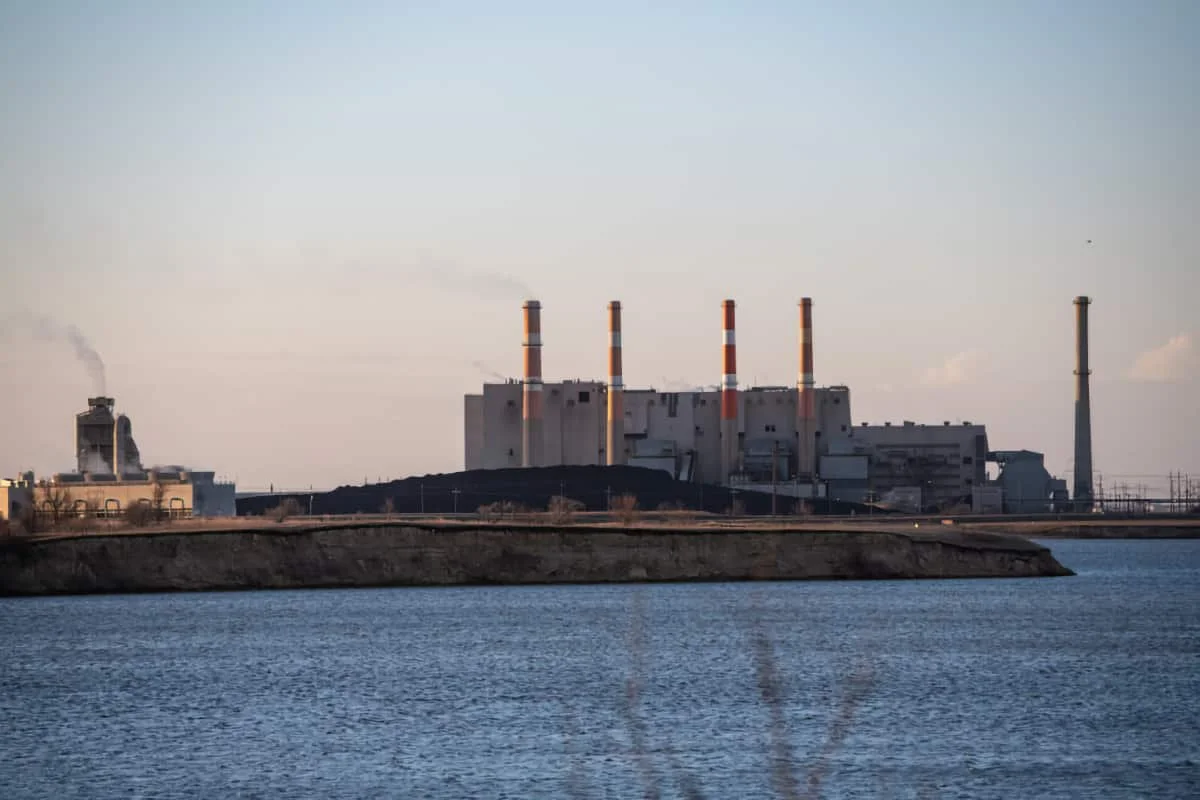
Boundary Dam Power Station on April 22, 2026, the day BD4 fired up again.. While it is difficult to see in this photo, if you crank up the contrast in Photoshop, you can indeed see hot exhaust coming from the Unit 4 smokestack, the third from the left. Photo by Brian Zinchuk
It was supposed to retire in 2021, according to federal coal regulations. Saskatchewan and SaskPower reached a coal equivalency agreement to stretch BD4 and sister Unit 5 a few more years. In return, Saskatchewan pledged to add 3,000 megawatts of wind and solar nameplate capacity to our grid by 2035.
It turns out we couldn’t afford to shut down Unit 4 entirely back in 2021. There were several occasions where it was fired up to supply power desperately needed for the grid. But in late 2024, it was shut down for good – or so it seemed at the time.
Just a couple months later, Minister of Crown Investments Corp and Minister Responsible for SaskPower Jeremy Harrison announced the province was seriously looking at refurbishing the coal fleet. On June 18, 2025, via a letter to SaskPower employees, he confirmed it was happening. By early 2026, the plan was laid out to bring back and refurbish the entire coal fleet between now and 2035, including the retired BD4 and 5.
Data centre link
Bringing back those two units, rated at 139 megawatts apiece, was crucial for what will be one of the most expensive projects in this province’s history. When it became clear Saskatchewan would soon be bringing nearly 300 megawatts of dispatchable, baseload power back onto the grid, the phones began ringing for SaskPower and the Government of Saskatchewan with data centre developers eager to build here.
The government chose Bell Canada as the successful developer, and this spring a new data centre to be built just southeast of Regina was announced. Its total economic impact is anticipated to be $12 billion. Its development is entirely tied to bringing Boundary Dam Units 4 and 5 back online as dispatchable baseload power. Its power requirement? Three hundred megawatts.
(Editor’s Note: SaskPower’s website says each unit is actually rated at 139 megawatts, but these numbers are frequently rounded up to 150 megawatts in many discussions.)
Federal coal regulations and the constitution
Bringing BD4 back to life is a clear violation of the federal coal regulations, which the Government of Saskatchewan has chosen to defy. Coal units were to only run 50 years and then be retired. The equivalency agreement gave us a few more years, but did not allow longer than that.
This was one of the principal points of the Saskatchewan First Act, introduced by then Minister of Justice and Attorney General Bronwyn Eyre. The Act says Saskatchewan will make its own decisions and rules on environmental standards, particularly those applying to greenhouse gas emissions and power generation. It reasserted Saskatchewan’s exclusive legislative jurisdiction under Section 92(A) of the Constitution of Canada, in particular, “the operation of sites and facilities for the generation and production of electrical energy.”
Harrison’s Saskatchewan First Energy and Security Strategy and Supply Plan, released in October 2025, laid out how coal will be used as a bridge to eventual nuclear power generation. That bridge could be several decades, with 2050 as the goal for net zero grid.
Jobs
When BD4 shut down, approximately 24 miners lost their jobs at the local Westmoreland Estevan Mine. Presumably, if less coal consumption led to fewer coal mining jobs, more coal consumption will lead to more.
Ken Hoste, assistant business manager of International Brotherhood of Electrical Workers Local 2067, said by email, “Credit goes to our IBEW 2067 Union members whose skill and pride in their work got BD4 running again. This was no easy task, especially given the condition it was in after being run to failure.”
He added, “The decision to keep coal generation is good for the entire province— stable, reliable electricity supports families, and gives business such as the recently announced data center the confidence to invest in Saskatchewan.”
There’s a lot more to bringing back BD4 than just doing some repairs and turning it back on.
CIC committee
BD4 received considerable discussion during the Legislature’s Crown and Central Agencies Committee meeting on April 21, where Harrison and SaskPower executives appeared, with most of the opposition’s points made by NDP Shadow Minister for Jobs and the Economy Aleana Young.
SaskPower vice president of Asset Strategy and Planning Gregg Milbrandt described the work done. He had extensive involvement in the 2011-2014 rebuild of BD3 and the carbon capture project, and has previously been director of both Boundary Dam and Shand Power Stations.
Milbrandt said the project ran from fall 2025 through spring 2026, on parallel tracks of mechanical restoration and regulatory recertification. It involved Boundary Dam staff, internal SaskPower groups, and 28 external vendors – nearly 62,000 labour hours across 360 work scopes under 40 operating permits, with zero lost-time injuries.
Of contracted services and material spend, approximately 82 per cent was Saskatchewan-based, 15 per cent within Canada, and 3 per cent outside Canada.
Background
BD4 was added to the system alongside BD3 in 1970. The two units share a common control room and operating staff. BD4’s last major turbine generator overhaul occurred in 2014, with the last minor overhaul in 2017. As the unit approached planned retirement, no further investment was made.
By end of 2021, BD4 was placed into lay-up mode and operated only when system conditions required it. In October 2022, one of two boiler feed pumps failed. The decision was made to de-rate the unit from 150 megawatts to 65 instead of rebuilding both pumps. The unit remained in lay-up at 65 megawatts until pressure equipment certification expired in November 2024, requiring full inspection, repair, and recertification.
Refurbishment
Milbrandt said BD4 was identified as an obvious return-to-service candidate because it could be completed in a short time frame with existing resources and no long-lead components. Site coordination was managed by Jody Waloshin, a senior Boundary Dam management employee.
Inspection findings drove the work. Internal boiler inspections required more than 433 cold shield repairs, approximately 42 cutouts, and 77 pad rolls to restore boiler pressure integrity, followed by non-destructive examination and a leak integrity test.
The feedwater train was rebuilt, including condensate extraction pumps and major work on the de-aerator after inspections revealed extensive cracking at shell-to-head welds. Affected de-aerator components were replaced rather than repaired. Boiler feed pumps and their 4160-volt motors were fully rebuilt, with some reverse engineering and custom-fabricated components due to obsolescence. Main steam lines and high-pressure piping were inspected to confirm fitness for service and meet TSASK certification requirements.
Additional work included rebuilds of turbine stop valves, control valves, bearings, and oil systems. Combustion support equipment was repaired, including pulverizers, coal piping, burner components, combustion air fans, and 4160 motors.
Harrison noted the cost to date to restore the 150 megawatts was $7.6 million. “In all of that, Madam Chair, we’re $7.6 million to return 150 megawatts of coal-fired power to the grid.”
Milbrandt said fire was successfully established in the boiler on April 17. Once temperature is reached, steam is emitted through the valves and the turbine is stretched out. At 3,600 rpm with equipment operating within expected parameters, BD4 will officially reconnect to the system. Online tests will then complete recertification. BD4 is targeted to fully return in May.
Cost
Young asked Harrison whether the total cost of the coal refurbishment project was the $2.6 billion SaskPower submitted to the rate review panel.
Harrison confirmed that figure covers the entire project: refurbishment of BD4, life extensions for Units 5 and 6, Boundary Dam 0 (shared infrastructure), Poplar River 1 and 2, Poplar River 0, Shand, and BD3.
“$2.6 billion for over 1500 megawatts of power,” Harrison said. “We are estimating right now if we were to build another Aspen power station, which we’re going to hit budget, I think it’ll be about $1.7 billion just on the capex at Aspen. We need four more of those. We need four more Aspens to replace the 1528 megawatts of coal-fired generation. We’re estimating for one of those four plants, $2.5 billion — for one. We need four. Our coal refurbishment, $2.6 billion. I think everybody gets the math.”
Harrison added that with coal, “we know where the coal is coming from, we know what it costs, and we know who owns it because it’s owned by the people of the province.” Roughly 90 per cent of the natural gas SaskPower uses comes from Alberta. Harrison noted the global LNG price has been around $18 per MMBtu (million British thermal units) for several weeks – more than 10 times the landlocked western North American price.
Article has been edited down for length. Used with permission.