
Kovels Antiques & Collecting: Salt Dishes
By Terry and Kim Kovel
Salt Dishes
Salt has played an important a role in human history as it does at the dinner table. It provides necessary nutrients, and it made food preservation possible long before refrigeration. The difficulty of obtaining it and the amount of processing required made it extremely valuable.
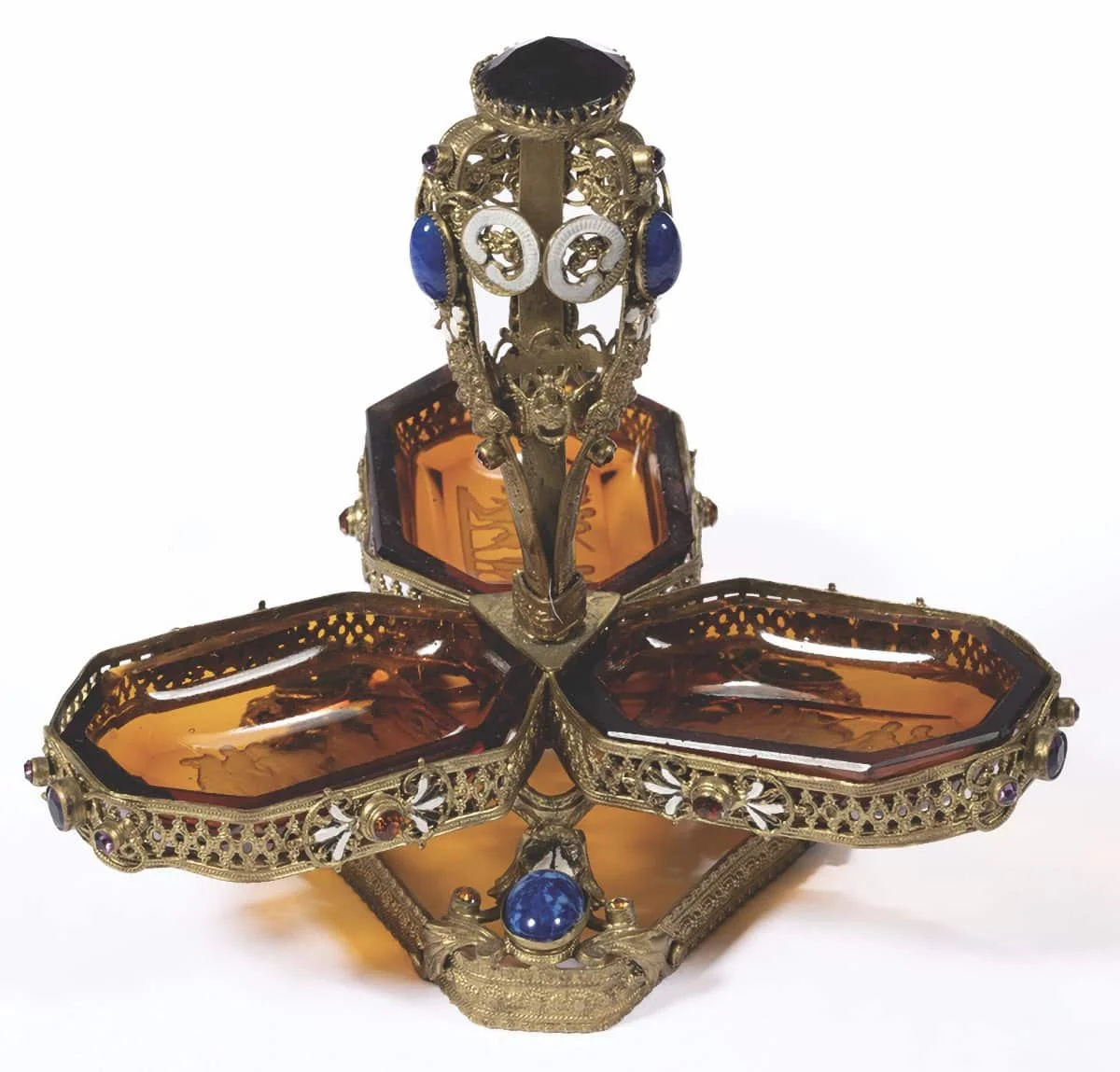
Most of us are used to having a saltshaker available at any meal. Ornately decorated salt dishes call back to a time when it was a luxury. PHOTO CREDIT: Jeffrey S. Evans & Associates
Many known prehistoric towns were salt production sites; human migration, trade, and even wars have been driven by access to salt. For centuries, salt was served at the table in open dishes, which collectors may call salt cellars, salt dishes open salts, or simply "salts."
It wasn't until the 1900s, after the discovery of additives that allowed for a finer grind and prevented lumping, that the familiar saltshaker became commonplace. Even then, some companies continued making salt dishes. They were often highly decorative, like this three-part open salt that sold for $584 at Jeffrey S. Evans & Associates. It was made in Czechoslovakia and dates to the 1920s. It features the rich colors and elaborate decorations collectors associate with the region's glassware.
Q: Being the curator at the Ward-Thomas Museum for over 40 years, we sometimes have strange things donated to the museum and become perplexed in trying to determine what they are and what they are used for. Such is the case of the 9x19-inch wooden board with many wire bars that slide into attached slots. A ledge-like piece on one side holds the wire bars in place. The wooden frame that holds the metal bars looks worn, leading me to believe it was held in some person's hands while using the item. If it is a part of something else, we do not know. There is no instruction pamphlet.
A: This came as a challenge to us, too, but we suspect that what you have is a pleater, or "plaiter," as it used to be called, to make pleats in fabric for home sewing. Similar devices, wooden boards about the same size with movable metal bars, were patented as "plaiters" in the late 1800s. Unlike the fluted irons or mechanical rollers available at the time, also known as crimpers or rufflers, these pleaters allowed for different types and sizes of pleats. Some surviving examples have paper labels with the maker's name and instructions for use, but these labels wear away easily.
TIP: A small chip in a glass goblet or vase can be ground off by a glass-repair expert, but there is little that can be done for cracks.
CURRENT PRICES
Lamp, oil, Vaseline glass, Sheldon swirl, opalescent, clear pressed stand, round foot, hurricane shade, 16 inches, $90.
Toy, Kiddy Cyclist, child on tricycle, red overalls, animals on wheels, multicolor, tin lithograph, windup, Unique Art Mfg., 8 1/2 inches, $110.
Barber, pole, red, white and blue stripe, paper, glass tube, steel and chrome caps, aluminum bracket, turns, lights up, William Marvy, 1950s, 18 1/2 inches, $450.
Furniture, day bed, Regency, mahogany, upholstered seat, turned ball feet, high scrolled arms, 31 x 85 inches, $1,660.
For more collecting news, tips and resources, visit www.Kovels.com
(c) 2026 King Features Synd., Inc.