
Kovels Antiques & Collecting: Paper Valentines
By Terry and Kim Kovel
Paper Valentines
For many of us, receiving paper valentines may be the stuff of school days -- a piece of the past. The tradition goes back much further, of course, and wasn't always just for kids. The first commercial valentines in America were made by Esther Howland in Massachusetts in 1850. They were made with paper lace and featured written verses. Before then, people exchanged homemade valentines. Surviving examples are collected as folk art today.
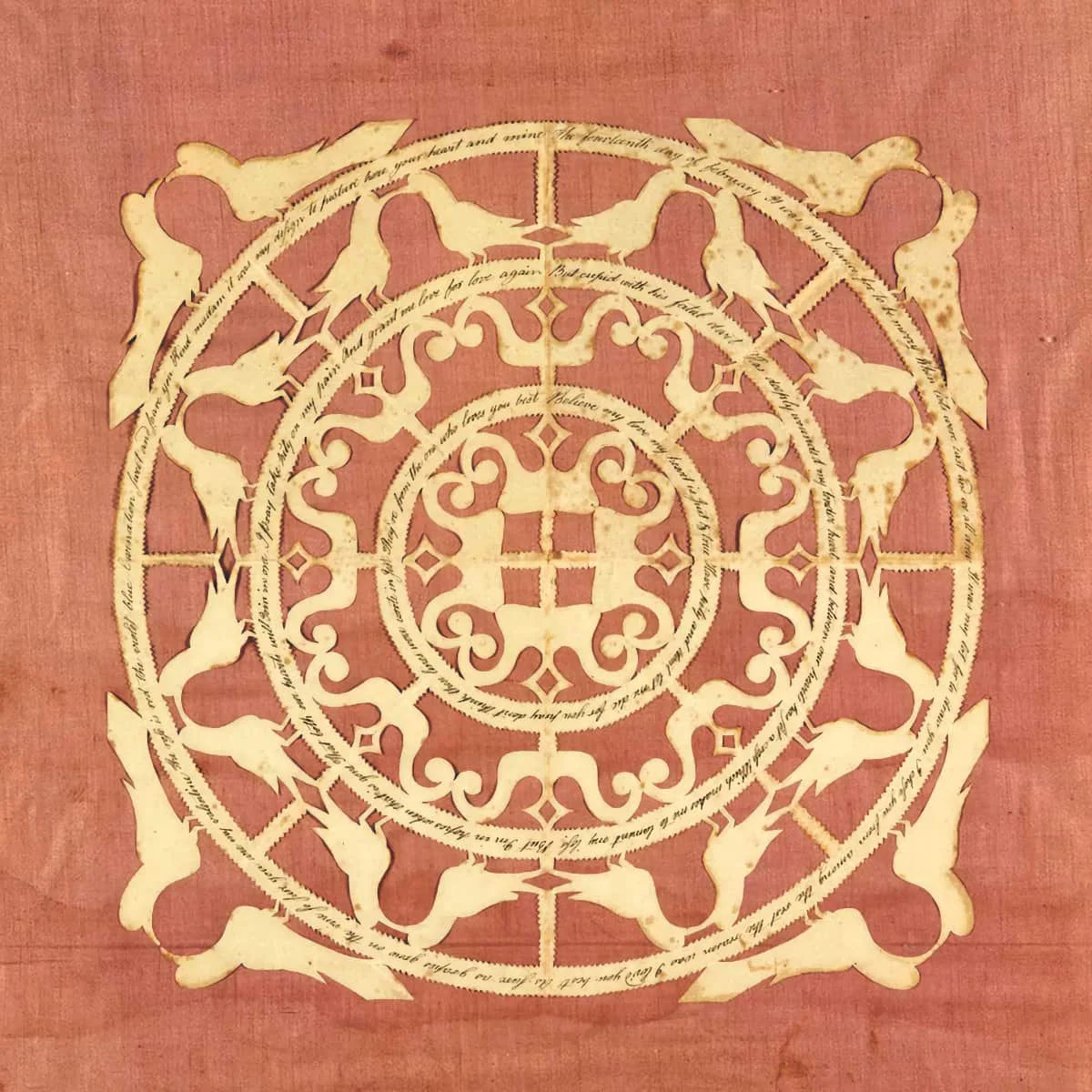
Happy Valentine's Day! This cut-paper valentine was made for February 14 over a century ago. Today, it is valued as a piece of folk art. PHOTO CREDIT: Jeffrey Evans & Associates
The one shown here, preserved in a frame with fabric backing, dates to the mid-1800s and sold at Jeffrey S. Evans & Associates for $279. It is an example of scherenschnitte (literally "scissor cuts"), a paper-cutting art that originated in Germany and was later brought to America. It was especially popular among the Pennsylvania Dutch. It features hearts, tulips, and birds known as distelfinks (a name for European goldfinches that means "thistle-finch"), all of which were favorite motifs. Scherenschnitte could be made for any festive occasion, or simply as artwork. We know this one must have been a Valentine because it is inscribed with a verse commemorating "the fourteenth day of February."
Q: I am curious about the bronze sculpture my father purchased from an estate sale around 1950. He converted the sculpture into a lamp. The sculpture shows a woman in a draped gown with one hand raised and the other arm outstretched. It is 27 inches high and weighs 26 pounds. I did not find any markings or signatures. Where was it made, when was it made, who was the artist and is there any value?
A: Bronze sculptures like yours were a common decoration in the late nineteenth to early twentieth centuries. They were often made in the art nouveau style of the time. The most famous were made in France, but some were made in other European countries and the U.S. as well. They were often copies of sculptures by famous artists. Many were made into lamp bases, like yours. Unmarked bronze sculptures or lamp bases usually sell for about $200. We have not been able to identify its maker, but a book like "The Encyclopedia of Bronzes, Sculptors & Founders" by Harold Berman may help. A library or museum in your area may have a copy.
TIPS on framing paper documents and prints: No glue, transparent tape, or rubber cement. No scissors -- don't trim anything. No pencils or pens, and don't try to rewrite an autograph. No staples or clips. No extremes of temperature or humidity. No direct sunlight -- it fades the ink.
CURRENT PRICES
Clothing, bodice, Edwardian, needle lace collar, frilly trim, French knot embroidery, trapunto, bracelet length sleeves, button back, cotton, 1905, 18 inches, $110.
Furniture, chest, hinged lid, twig decorated, robin's egg blue paint, applied stars and crescent moons, shaped bracket base, 20th century, 23 1/2 x 33 1/2 inches, $450.
Glass-Venetian, lamp, electric, figural, fruit basket, multicolor, turquoise blue base, paper label, Murano, c. 1980, 8 1/2 x 9 inches, pair, $2,065.
For more collecting news, tips and resources, visit www.Kovels.com
(c) 2026 King Features Synd., Inc.