
Kovels Antiques & Collecting: Millville Glass
By Terry and Kim Kovel
Millville Glass
What cities come to mind when you think of glassmaking? Venice, Italy? Waterford, Ireland? Sandwich, Massachusetts? How about Millville, New Jersey? Millville had a thriving glass industry by the 1860s. Many glassworkers were immigrants, familiar with techniques like lampworking and millefiori that had been practiced around the Mediterranean for hundreds of years.
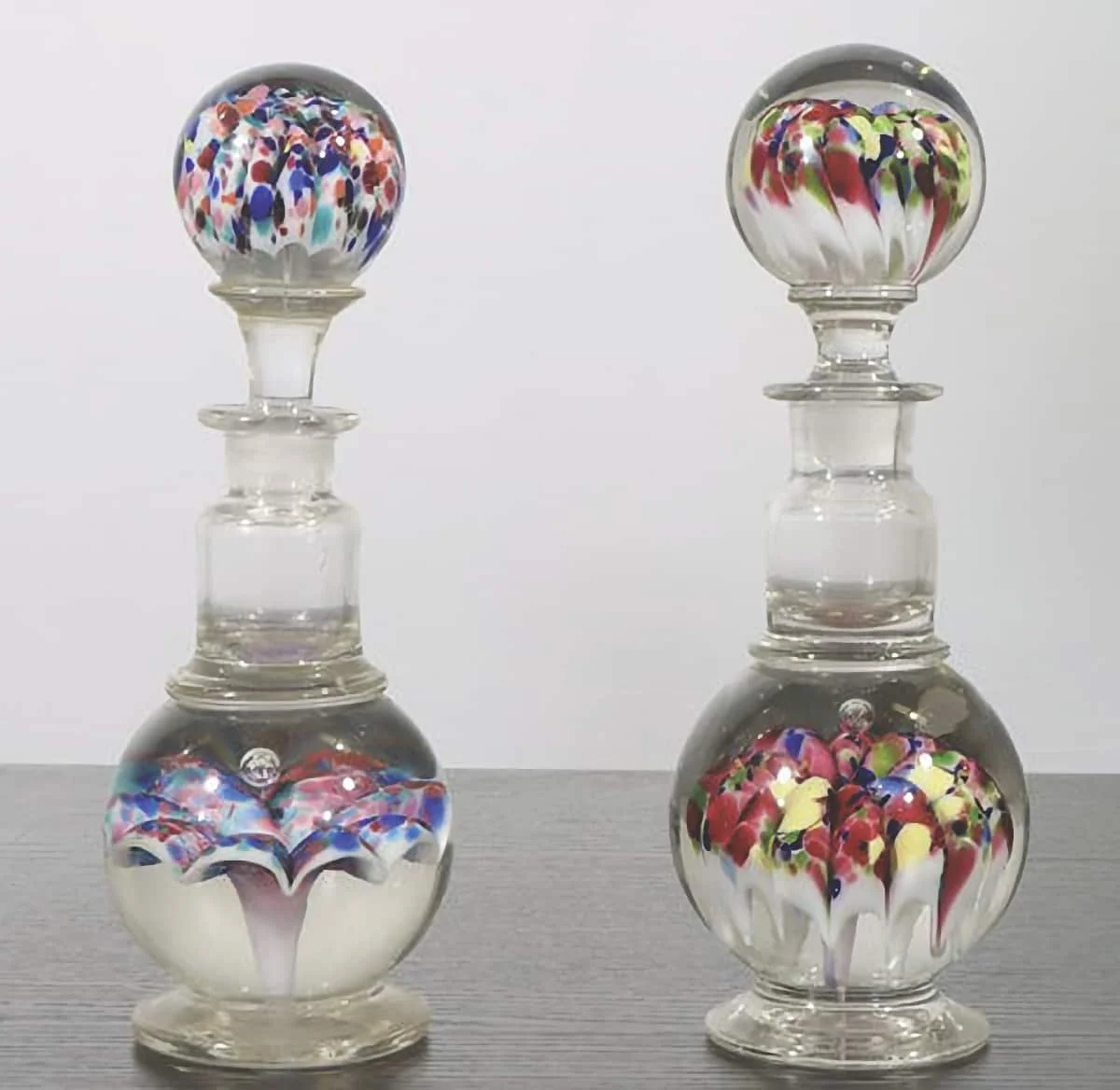
These paperweight inkwells demonstrate the unique glassmaking styles of Millville, New Jersey, and showcase the skill and creativity of their glassworkers. PHOTO CREDIT: Alderfer Auction Company
Working in the Millville factories, they developed and experimented with new techniques, often by making paperweights. These paperweights were not production items; glassworkers made them on their own time to try out techniques or to sell or give to friends and family. They were part folk art, part glass art.
The most famous design was the "Millville rose," which had a realistic-looking rose with crimped petals and leaves inside the clear glass ball. Another design, made by pulling chips of colored glass, is said to be inspired by a lily flower, but is today called the "umbrella." The two paperweight inkwells pictured here, which sold together for $256 at Alderfer Auction Company, have the umbrella design.
Q: I have a color print by Currier & Ives. How can I tell if it is an original?
A: Currier & Ives made their famous lithograph prints from 1857 to 1907. They have been reproduced many times since then. Check the size of your print. Currier & Ives prints were originally made in specific sizes. They could be very small (up to 7 x 9 inches), small (8 4/5 x 12 4/5 inches), medium (9 x 14 inches to 14 x 20 inches), and larger. Other sizes are usually later reproductions. Sometimes, original prints are trimmed to different sizes, which lowers their value. There are many books on Currier & Ives prints that can help you identify and value yours. Look for them at your library. A dealer who specializes in prints or books may be able to help you authenticate yours by its coloring, paper and printing method.
TIP: If using a glass shelf to display a paperweight collection, be sure it is strong enough. The ideal size is 18 inches long, 4 inches deep, 1/4 inch thick. Paperweights are heavy, and collectors tend to add "just one more." Glass will become more brittle and break with age.
CURRENT PRICES
Folk art, birdfeeder, figural, house, Dutch Colonial style, porch, windows, red chimneys, hinged roof, wood, metal tag, Henry Mayster, c. 1981, 19 x 43 x 27 inches, $185.
Paper, ticket, Grand Ballon Captif, hot air balloon, 50 centimes, cancellation stamp, Paris, 1879, $415.
Jewelry, necklace, Navajo, turquoise, squash blossom, pendant, 10 blossoms, beaded chain, silver, signed, Henry Sam, late 20th century, 26 inches, $1,185.
Program, Illinois Rally For Civil Rights, I Cared I Was There, Martin Luther King, Jr. photograph, June 21, 1964, trifold, 18 x 8 inches, $1,300.
For more collecting news, tips and resources, visit www.Kovels.com
(c) 2025 King Features Synd., Inc.