
Kovels Antiques & Collecting: Lacquerware
By Terry and Kim Kovel
Lacquerware
Picnics are a favorite way to celebrate the spring weather. But most of us wouldn't pack ours in a box like this one, which sold for $2,560 at an auction by Nye & Company. This five-tiered lacquer picnic box was made in Japan in the 18th century. It was probably for a wealthy family whose crest graces the top. Today, it is a work of art, and similar Japanese lacquer picnic boxes appear in museum collections around the world.
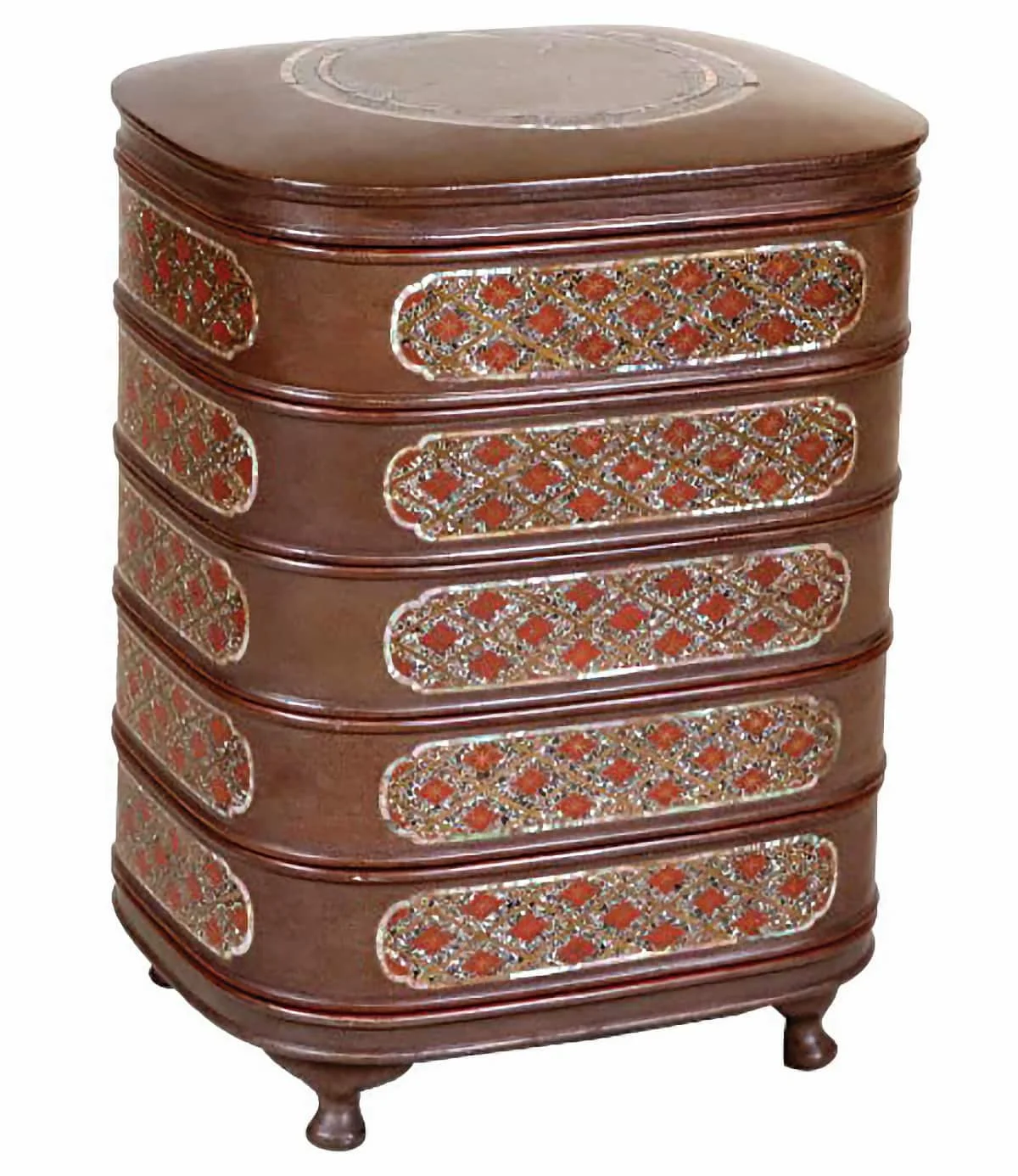
Shimmering aventurine lacquer and mother-of-pearl inlay make this 18th-century Japanese picnic box a work of art. PHOTO CREDIT: Nye & Company
Lacquerware has been made in Japan for thousands of years, with the earliest examples dating to 7000 to 5500 B.C. Elaborate decorating styles emerged by the eighth century. Over the next few hundred years, artists developed techniques incorporating multiple lacquer colors and inlaid materials like shell, ivory, mother-of-pearl, or metal foils or powders.
This picnic box features a mother-of-pearl inlay and a lacquer technique called nashiji, in which gold or silver flakes are scattered into layers of translucent lacquer while it is still wet. In English, this technique and similar methods used in European decorative arts are called aventurine, after the gemstone it resembles.
Q: I have some antique handwritten documents and would like to know their value. They are an invoice dated April 1795 for supplies aboard the Brig Lydia, a memo written and signed by Booker T. Washington on Leland Hotel of Chicago letterhead dated June 25, 1896, and a December 1852 framed stanza of "A Psalm of Life" written by Henry W. Longfellow.
A: The most valuable antique documents are the ones signed by famous historical figures or associated with major events. Your documents, signed by Booker T. Washington and Henry W. Longfellow, certainly qualify. Dr. Washington (1856-1915) is one of the most significant educators in American history. In 1881, he founded the Tuskegee Normal and Industrial Institute, a school that provided academic and vocational training for African American students and served as its first principal and president. Documents with his signature can be worth about $250 to $500.
Henry Wadsworth Longfellow, author of epic poems like "The Song of Hiawatha" and "Evangeline," was 19th-century America's most beloved poet. He was a celebrity in his own time, and his cultural impact is still felt today. Handwritten, signed stanzas of poems by Longfellow can be worth about $500.
Your invoice is a little more difficult to value; it may be worth anywhere from about $50 to $200. For more information, you may want to contact a dealer or auction house specializing in autographs, antiquarian books, or historical Americana.
TIP: Dirty lacquer can be cleaned with a paste of flour and olive oil.
CURRENT PRICES
Glass-contemporary, vase, globular, iridescent, white pulled loops, label. Pele's Glass, Hawaii, 5 x 7 inches, $50.
Sampler, alphabet, numbers, multiple geometric borders, multicolor, linen, signed, dated, frame, Maria Blake, 1817, 15 x 13 inches, $280.
Bookends, cat, stylized, back arch, tail raised, head turned, round eyes, rectangular base, copper, Walter von Nessen, Chase Brass & Copper Co., 7 1/2 x 4 inches, $800.
For more collecting news, tips and resources, visit www.Kovels.com
(c) 2026 King Features Synd., Inc.