
Kovels Antiques & Collecting: Hall Trees
By Terry and Kim Kovel
Hall Trees
With April showers comes the question: What do you do with your dripping raincoats and umbrellas? By the Victorian age, wealthy households had hall trees or hall stands in the entryway. They were functional pieces, kept against a wall to save space and featuring a place for everything: coat hooks, an umbrella stand, a bench with storage and often a shelf for small items. They usually have a mirror, too; after all, you want to look your best when you're leaving the house or visiting someone else's.
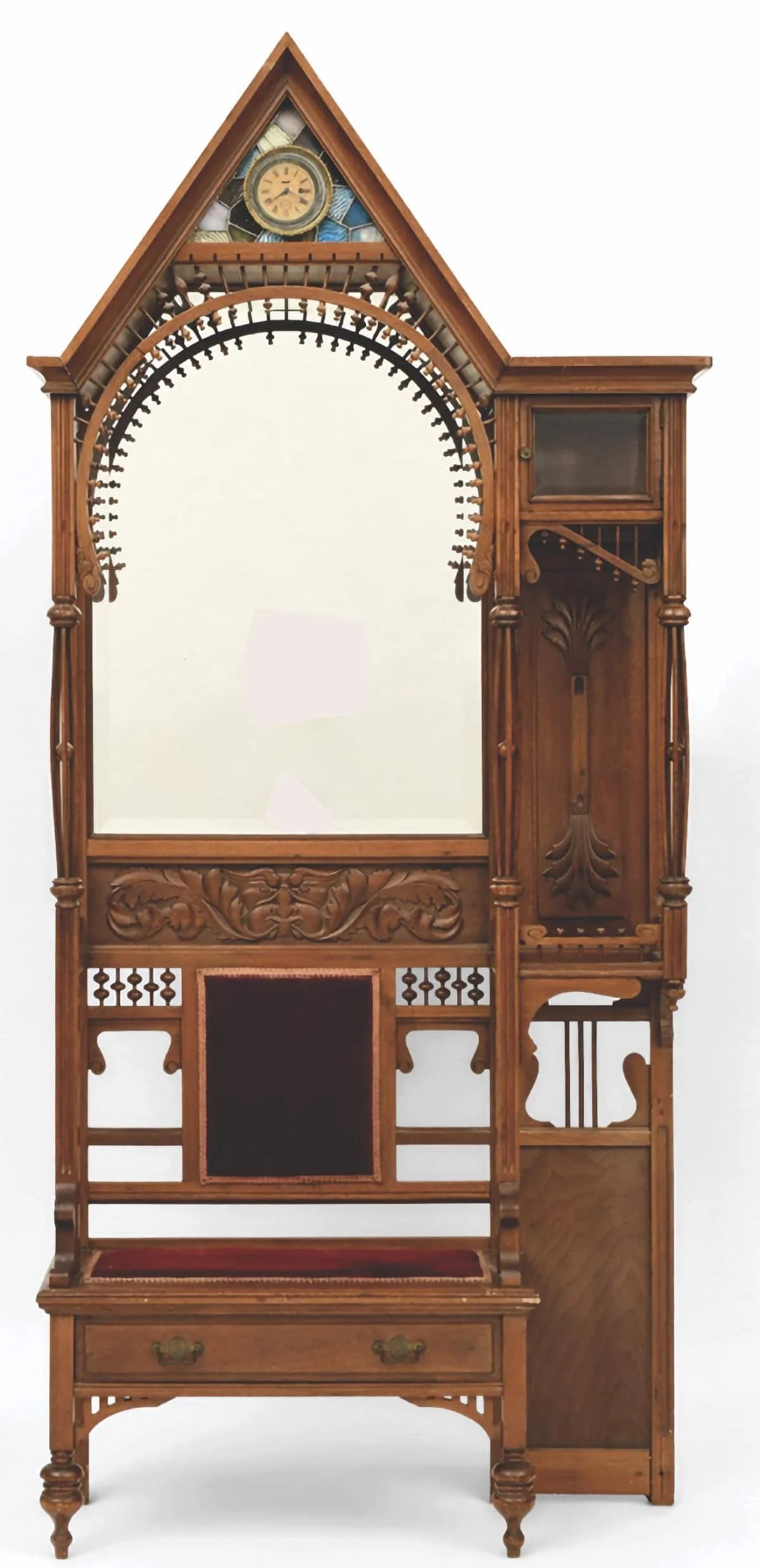
Hall trees were both decorative and functional. This one from about 1900 features an upholstered seat, stained glass and a clock as well as the typical umbrella stand, bench and mirror. PHOTO CREDIT: Fontaine's Auction Gallery
And speaking of looks, hall trees were rarely just functional; they were often highly decorative. This one, which sold at Fontaine's Auction Gallery for $1,875, was made about 1900, placing it at the end of the Victorian era. In addition to carvings and stick-and-ball decoration, it has a few unusual details. Instead of a storage bench, there is a drawer under the upholstered seat. A colorful leaded glass panel graces the top, and an inset clock adds yet another functional feature.
Q: I have some antique books I would like prices on. There are about 24 little books with green leather covers and some Big Little Books. How can I find someone who wants to buy them?
A: Your green leather books sound like they are from the Little Leather LIBRAry, a publishing company founded in New York in 1915. They published classic literature titles in miniature format for affordable prices. They were first made as advertising premiums for the Whitman's Candy Company of Philadelphia. Then they were sold at retailers like Woolworth's, where they cost 10 cents each. The green covers are synthetic leather, which the company started using during World War I. By 1922, they changed the books' binding to a shiny red leatherette and operated as the Little Luxart Company.
Big Little Books were published by the Whitman Publishing Company in Racine, Wisconsin, starting in 1932. They were about 3 1/2 by 4 inches, had full-page illustrations and originally cost 10 cents each. The first title was "The Adventures of Dick Tracy." Other Big Little Books also featured popular radio, comic strip and film characters, including Disney characters. In 1938, Whitman changed their name to Better Little Books.
The prices of your books depend on the rarity of the titles. Today, individual Little Leather LIBRAry books can sell for about $5 to $30 each. Big Little Books are usually under $20 each. The easiest way to sell books like these is through a local used bookstore.
TIP: Mirrors made before 1850 had thin glass. To judge the thickness of a mirror, hold a pencil point against the glass. The difference between the point and the reflection is the thickness.
CURRENT PRICES
Clock, Coca-Cola, round, red center, Drink Coca-Cola, metal, Telechron, 1951, 18 inches, $60.
Textile, wall hanging, embroidered, pictorial, two cranes, marsh landscape, trees, bamboo, flowers, silk, Japan, late 1800s, 83 x 63 inches, $350.
Furniture, linen press, mahogany, split scrolled crest, scallop finial, twist pilasters, two doors over two short over two long drawers, England, 1800s 85 1/2 inches, $900.
For more collecting news, tips and resources, visit www.Kovels.com
(c) 2026 King Features Synd., Inc.