
Kovels Antiques & Collecting: Green Family
By Terry and Kim Kovel
Green Family
"Famille verte" is a term collectors use for a popular style of Chinese porcelain. If you speak French (the term was coined by French collector Albert Jacquemart in the 1860s), you know it means "green family." It refers to a type of porcelain decorated with multicolor enamel, called wucai, or "five-color" in Chinese, where green is the dominant color. In Chinese, it is usually called Kangxi wucai because it was developed during the reign of the Kangxi emperor of the Qing dynasty, who ruled from 1661 to 1722. It experienced a resurgence in popularity in the 19th century, when it was made for export to the West.
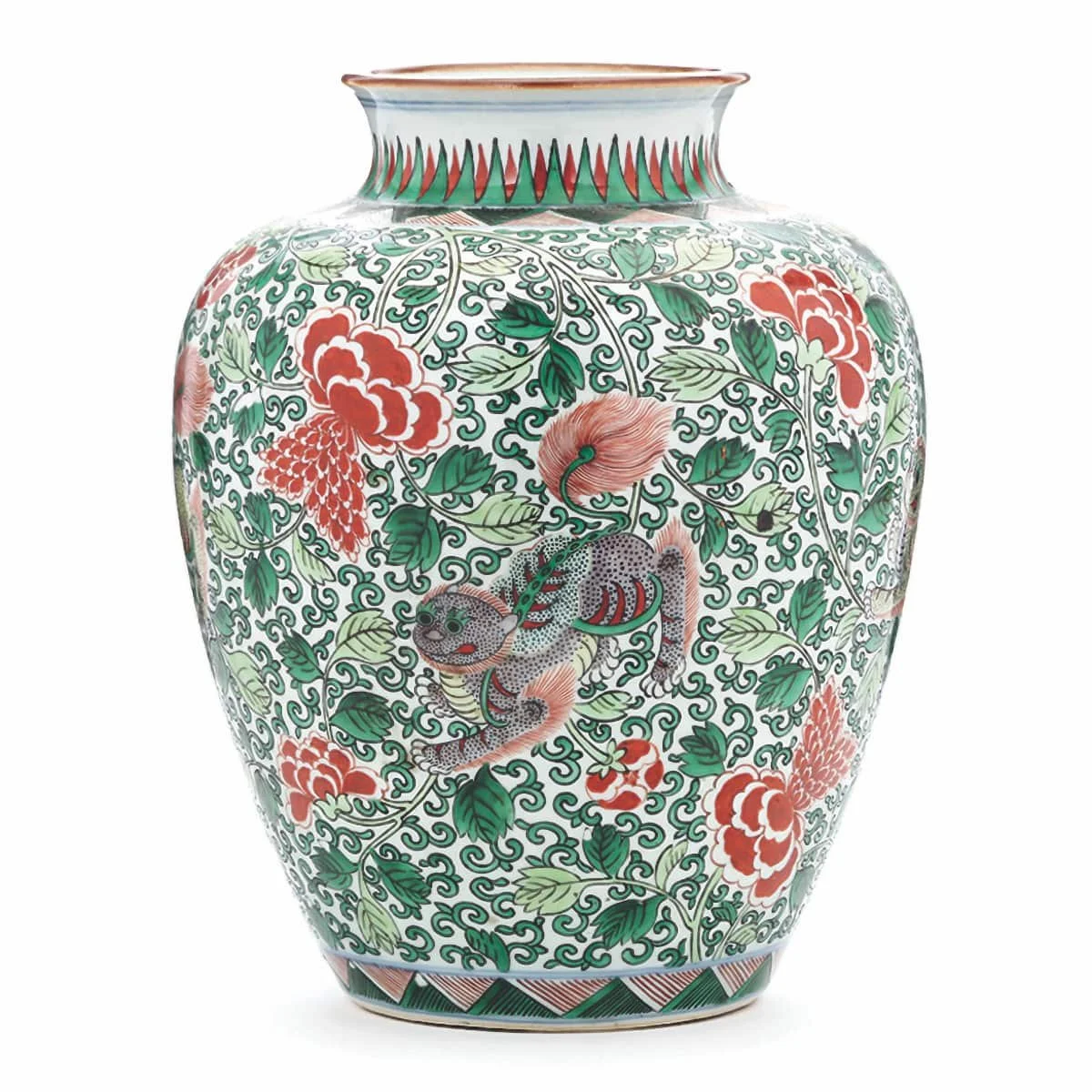
There's no doubt that a vase like this one belongs to the famille verte, or "green family" of Chinese porcelain. Spring peonies and foo dogs are popular symbols. PHOTO CREDIT: Leland Little
The predominance of green enamel lends itself well to designs with leafy plants, like this 19th-century vase that sold for $600 at an auction by Leland Little. Like many Chinese porcelains, its decorations have symbolic meanings. The plants that cover the background are peonies, which are associated with royalty and wealth. They are also the flowers of spring.
The auction house described the animals on the vase as "Buddhist lions," after the guardian lion statues often seen outside Buddhist shrines. However, English-speaking collectors often call them "foo dogs" because of their resemblance to certain Chinese dog breeds known as "lion dogs."
Q: We have a chest sent to us after WWII that looks like it was made in Japan. It is rectangular with a flat top, landscape design on the lid and front, and bracket feet. Could you identify it and tell us its worth? It is 18 inches high, 17 inches wide, 35 inches long.
A: Many countries in East Asia made furniture to export to the United States in the mid-20th century. These included chests like the ones you describe. The chest's material may provide clues to its origin. Chests from Japan are often decorated with designs painted on lacquer or with applied metal plaques. Chests with carved designs, often made of camphor wood, were a popular export from China and Hong Kong. Today, most mid-century exported chests like these are worth about $50 to $100.
TIP: Remove stains from old ceramic vases by scrubbing them with salt.
CURRENT PRICES
Lampshade, milk glass, ball, hand painted, turquoise blue top, green scrolling trim, leafy vine, pink flowers, 10 inches, $50.
Silver-Irish, teapot, hinged lid, swan finial, scalloped, chased body, landscape, four legs, twisted, lion's masks, paw feet, marked, Dublin, 1969, 7 x 9 inches, $640.
Rug, soumak, six medallions, blue field, red, orange, brown, ivory, stylized flower border, Uzbekistan, 9 feet 6 inches x 5 feet 7 inches, $745.
Wood, porridge container, lid, round, painted, multicolor, ridged body, blue, crown shape handles, scrolled trim, lettering, Scandinavia, 12 x 13 inches, $1,030.
For more collecting news, tips and resources, visit www.Kovels.com
(c) 2026 King Features Synd., Inc.