
Kovels Antiques and Collecting: Garden Ornaments
By Terry and Kim Kovel
Garden Ornaments
They say that imitation is the highest form of praise, and it follows that the most desirable antiques are often the most reproduced. Take the famous "Wally Birds" made by Martin Brothers of England in the late 19th to early 20th centuries. These fanciful stoneware bird figures with heavy texture, colorful glazes, and endearingly grotesque faces can sell for $50,000 or more. Unsurprisingly, they have many imitators that sell for lower prices. But less expensive doesn't always mean inexpensive.
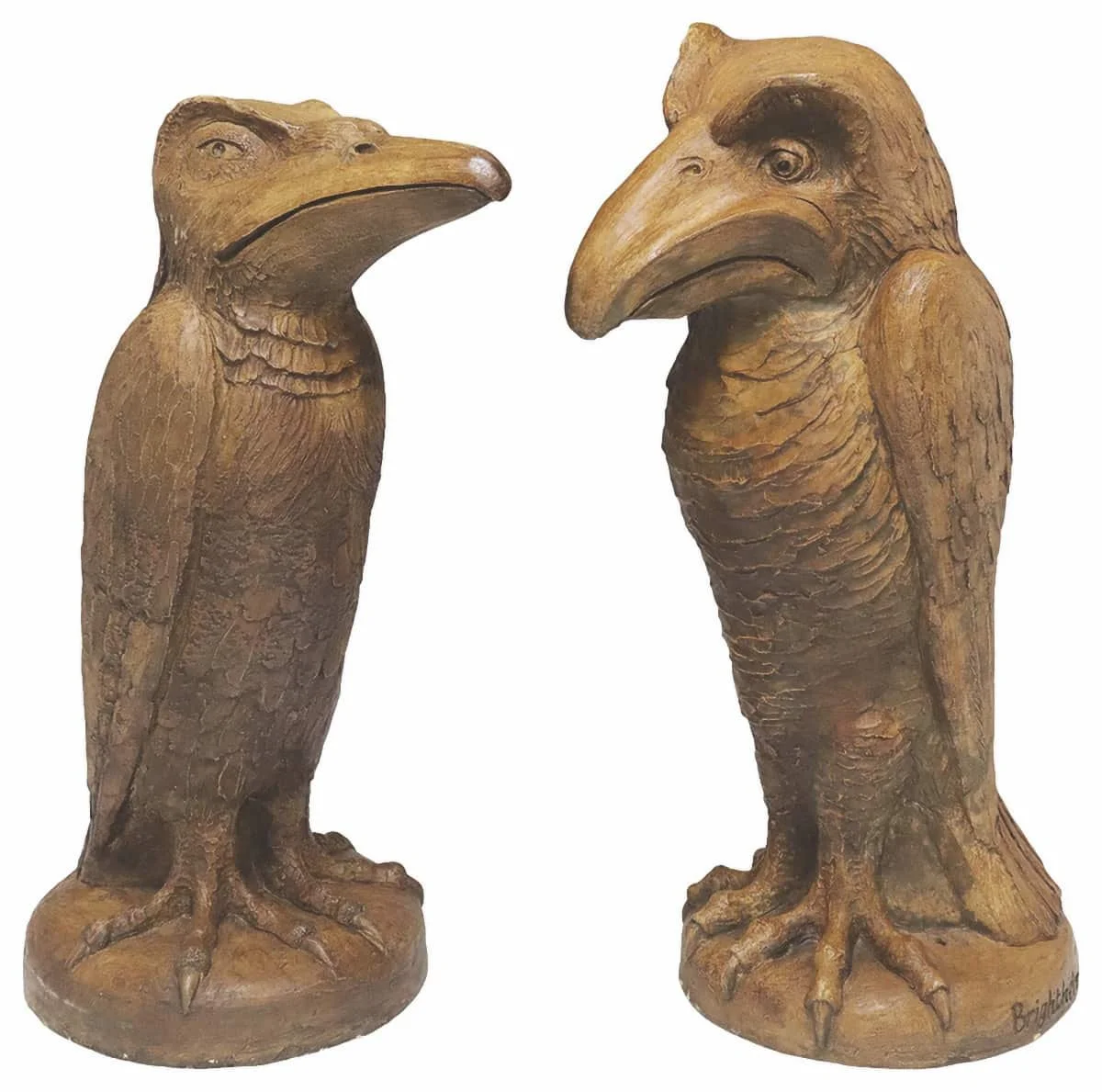
These cast stone garden sculptures look like the famous bird figures by the Martin Brothers but don't quite reach the same price. PHOTO CREDIT: Austin Auction Gallery
This set of two garden statues inspired by Martin Brothers's birds sold for $1,037 at Austin Auction Gallery. It's a low price for a pair of Wally birds, but fairly high for a vintage garden ornament. There's no mistaking these Martin-style birds for the real thing. They are made of cast stone (a type of cement), not stoneware pottery, so they do not have the characteristic glaze. But their oversized beaks and almost humanlike facial expressions carry the same comical charm.
As garden figures, they continue a tradition of grotesque garden statuary that extends back to the Renaissance, if not earlier. In addition to adding a touch of whimsy, personality, and maybe a little mystery, grotesque figures are sometimes said to help repel things you don't want in your garden, from supernatural portents of bad luck to more practical concerns like plant-nibbling pests.
Q: Can you tell me how I can identify a painting? I have a framed painting of an autumn landscape that I would like to sell. It does not have a signature.
A: Identifying a painting without an artist's signature is usually difficult. Your best option is usually to contact a museum or art dealer in your area. Some museums have public events where they will authenticate art. They may also have access to resources like online databases that can help you research and identify your piece. If you cannot identify the artist, the value of your painting can be determined by its medium, subject matter, and even its size. If you can identify the landscape as a specific location, that will add to its value, especially to buyers in that location. Buyers will be interested in your painting for its decorative value, so consider where it would fit on a wall. Paintings that are very high and narrow usually sell for about 30% less than a painting of the same quality sized to fit over a sofa or fireplace. If the frame is high quality, period-appropriate, or suits the painting's aesthetic, that will also add to its value.
TIP: Outdoor stonework and statues can be damaged by acid rain, frost, and plants, like ivy. Put garden statues on stands to keep the moisture from the grass away from the statue. Wash with a hose and a soft brush.
CURRENT PRICES
Halloween, decoration, die cut, pumpkin house, on wheels, pulled by black cat, walking on two legs, wearing orange overalls and pointed hat, cardboard, two-sided, 5 x 7 inches, $85.
Pearlware, punch bowl, ladle, black transfer, nautical scenes, Jolly Boatswain center, short foot, England, mid-1800s, 5 x 11 1/2 inches, $185.
Toy, tractor, pedal, red paint, three wheels, black and white decals, International Harvester, $530.
For more collecting news, tips and resources, visit www.Kovels.com
(c) 2026 King Features Synd., Inc.