
By Terry and Kim Kovel
Ceramic Trees
Artificial Christmas trees have been around since the 19th century, if not earlier. Trees made of dyed feathers originated in Germany and were introduced to the U.S. by the early 20th century. The mid- to late-20th century saw trees made from several new materials. The famous aluminum Christmas trees, sparkling in silver before any lights or ornaments were added, were first made in the 1950s. New types of plastic that gained widespread use after World War II proved to be perfect for making durable, realistic-looking synthetic pine needles. But one tree trend of the 1950s to 1970s used a very old material: ceramic.
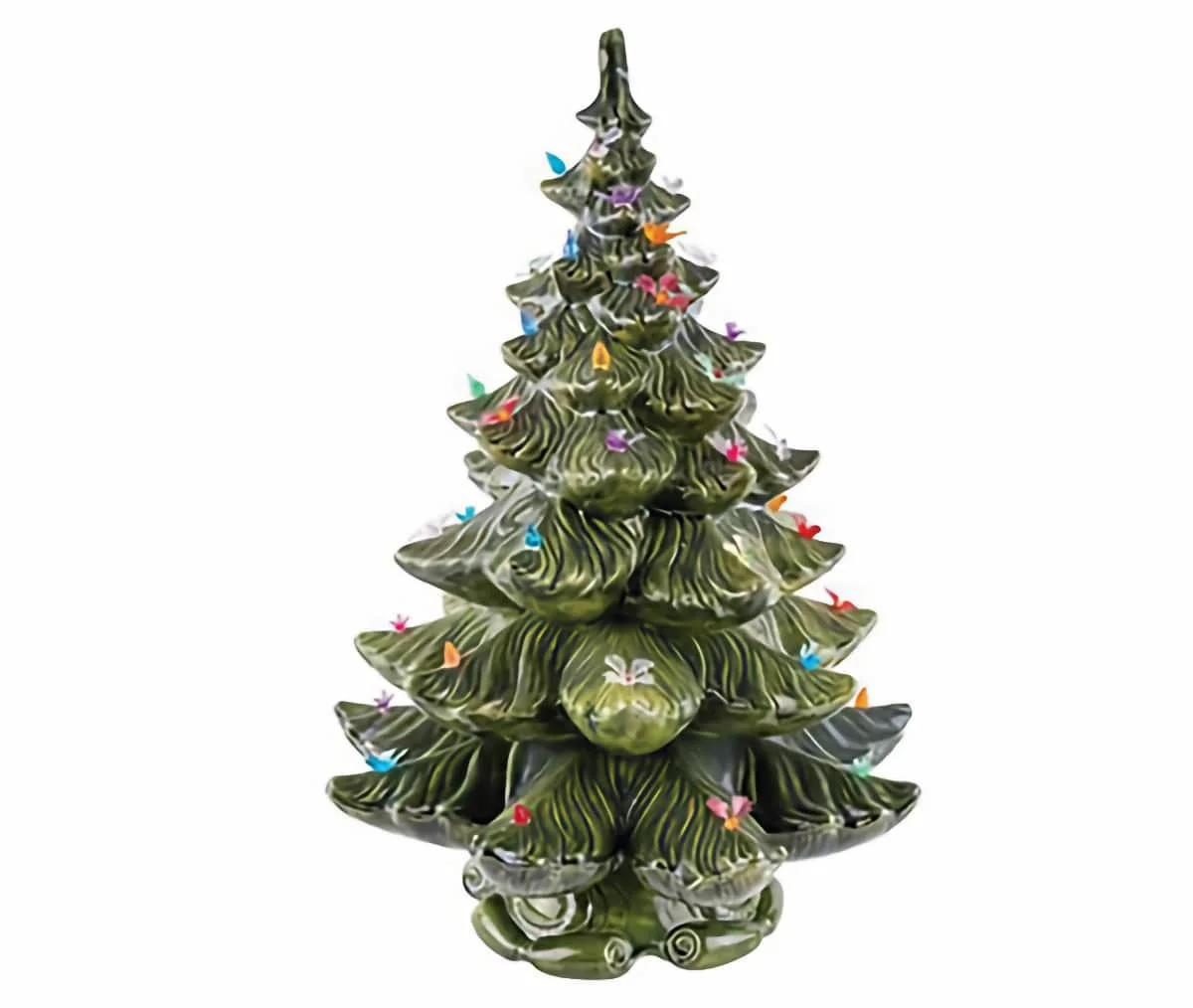
Ceramic trees like this one have color, light, and, in this case, music. They last for decades with no risk of drying out and losing their needles. PHOTO CREDIT: Keystone Auctions LLC
Small ceramic Christmas trees measuring between 12 and 24 inches were just the right height to display on a table. An electric light hidden in the attached base shines through the transparent plastic ornaments attached to the tree's limbs, and the tree often came with a small star to put on top.
While many companies made trees like these, the most famous are by the Atlantic Mold Company, which continued making them until 1999. Atlantic Mold trees are usually marked, but, as with many ceramics, be careful if the mark includes a date. It might be the date the mold was created; the tree itself may be newer.
An unusual example sold at Keystone Auctions LLC for $127. It is unmarked but has a scrolled base like the Atlantic Mold tree. At 23 inches, it is taller than the usual ceramic tree. A close look shows the tiny plastic bulbs come in shapes like birds and holly sprigs, adding extra festive touches. And one more detail doesn't come through in pictures: a music box in the base.
Q: My grandparents bought a settee in the 1920s. I have it now, and it has been refinished and reupholstered. It has interesting gold trim with carved human faces on the upper arms. Can you tell me anything about it and what it might be worth?
A: Furniture with gold trim and carved masks has come into fashion many times; most notably during the American Empire (c. 1815-1840) and Greco-Egyptian Revival (c. 1860-1890) periods. Decorations like these, as well as imagery like sphinxes, winged mythological figures, and furniture feet carved to look like animal hooves or paws evoked a sense of the ancient world and its luxury and exoticism. They were inspired by major archaeological expeditions.
There was another Egyptian Revival in the 1920s, after the discovery of King Tutankhamun's tomb. Designers incorporated Egyptian-inspired motifs in art deco furniture and jewelry. The value of your settee will depend on its material and condition. Identifying a maker will increase the value. Settees from the 1920s without a known maker can sell for anywhere between about $150 and $500.
TIP: A little damage and wear add to the charm of old Christmas ornaments. It indicates an antique that has seen many holidays of use. Restoration lowers value.
CURRENT PRICES
Christmas tree, stand, cast iron, molded house and flowers, pierced base, four panels, train, boat, car, zeppelin, figures, four-footed, Germany, 8 1/2 x 10 inches, $110.
Bells, sleigh, 28 brass bells, light brown leather strap, cotter pins, buckle, 74 inches, $150.
Candy container, Santa Claus, holding Christmas tree, red cap and coat, blue trousers, white trim, fur beard, molded and painted face, mica, Germany, 14 1/2 inches, $1,080.
For more collecting news, tips and resources, visit www.Kovels.com
(c) 2026 King Features Synd., Inc.