
How many nuclear reactors is Saskatchewan going to build?
By Brian Zinchuk
ESTEVAN – Just how many nuclear reactors is SaskPower planning for?
SaskPower president and CEO Rupen Pandya addressed Estevan City Council as part of the company’s ongoing consultations, and touched on the subject in that presentation and in an interview session with the media.
Pandya told Estevan City Council the Crown corporation was looking at two small modular reactors near Estevan, and four near Elbow.
That’s an increase of two units compared to the original announcement made in the spring of 2022, when SaskPower initially said it intended to build small modular reactors in this province.
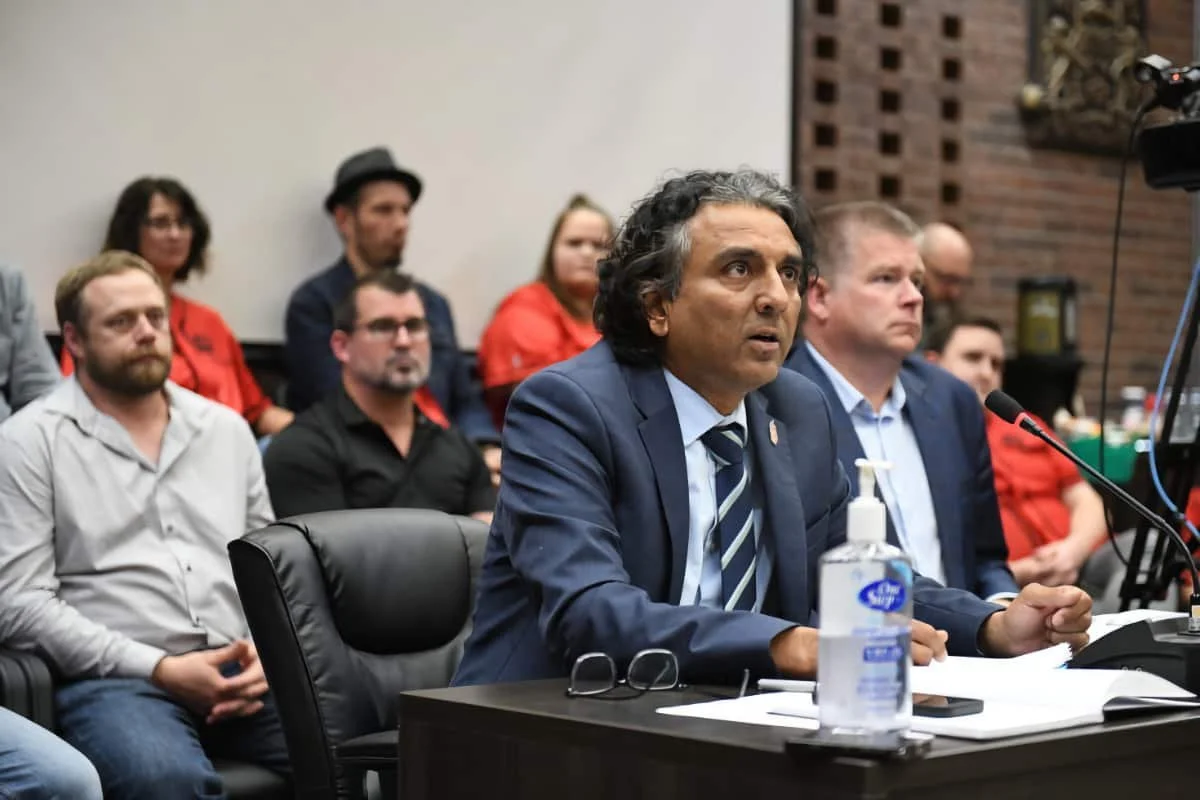
SaskPower president and CEO Rupen Pandya, speaking before Estevan City Council on Sept. 25, 2023. Photo by Brian Zinchuk
But is that the be-all and end-all? The number of reactors appears to be in flux these days. Don Morgan, who was Crown Investments Corporation and SaskPower Minister until a cabinet shuffle a week or so later, said this on John Gormley Live on Aug. 22:
“Depending on availability of money, we should be looking probably at four or six,” he said, regarding building General Electric-Hitachi 300 megawatt small modular reactors (SMRs). But in the same interview, he added, “We should be probably planning for seven, eight or nine.”
Weyburn-Big Muddy MLA Dustin Duncan replaced Morgan in the Crown Investments Corporation and SaskPower portfolios.
And two days later, on Aug. 24, Pipeline Online asked Premier Scott Moe about Morgan’s comments on Gormley. Moe responded, “I don’t think that that number certainly hasn’t been decided on, as of yet. But as we look ahead, through the decades, and not the next number of years, but through the decades, you know, we’re embarking down that path with going through the regulatory process on where you may locate and a small modular reactor, and how many you can ultimately locate at that.
“So I won’t surmise as to what the end number would be of small modular reactors, because other are other options, and larger 1,000 megawatt reactors and such. There’s other, options that we have that can play into this as well, with some of the other generation infrastructure that we have.”
Pipeline Online asked about this on Sept. 25. Pandya said, “I can tell you right now that the company is focused on the next SMR, confirming the decision makers have all the information that they need with respect to financial, technical, environmental aspects of the next SMR and so that they can make that decision. You know, clearly going forward, is if you think about electrification, and its impact on Saskatchewan grid, we’re 5,400 megawatt grid right now, more or less, and, if full electrification takes place, we’re looking at being a 10,000 megawatt grid by 2050. And the question that you’re asking is what makes up that, that difference? And like I said, right now, we’re focused on the first SMR. But certainly, going forward, we will be actively planning for how we respond to power growth requirements in the province.”
Notably, Pandya did not give a number of reactors in the interview. When pressed on that, he said, “Right now we’re confirming decision on construction of the first SMR in the province.
“I would tell you just generally that, from an economic perspective, if you’re deploying a nuclear technology, it makes better sense, economically speaking, to have more than one. It helps distribute some of the operational costs, but certainly, in terms of operational efficiency, there’s an improvement there as well. So, but right now, the decision that, we’re taking forward to government, for 2029 will be the build out of Saskatchewan’s first SMR.”
Asked about building SMRs both at Estevan and Elbow, he said, “Well, we’re currently looking at both the Elbow area and Estevan right now to site the first SMR. And, going forward, like I said earlier, we will actively look at what the power requirements are in the province, and how we’re going to respond to that power requirement. If it is SMRs, we’ll need to look at everywhere we can just deploy SMRs effectively. And certainly right now, Estevan and Elbow already identified as the two regions that are most a conducive to those buildouts.”
Not so small reactors?
A possibly key development in October, 2022, was Saskatchewan-based Cameco’s purchase of 49 per cent of reactor builder Westinghouse. While their reactors have not been built or designed here, buying from aa Saskatchewan-owned company raises the question of “buying local,” so to speak, and Westinghouse offers 1,000 megawatt reactors, the size the premier referenced.
With regards to the possibility of large, 1,000 megawatt reactors, and why SaskPower has gone with small modular reactors of 300 megawatt capacity, Pandya said, “Right now the large reactors in Canada are around that 700 to 1,000 megawatts of generating capacity. And at present based on the 5,400 megawatt grid, that’s a little bit too large for us to integrate. We have NERC requirements that require us to have a backup generation that is equivalent to our largest generator. And so right now, our largest generators are essentially 300 megawatt generators. And so, the GE-Hitachi technology that we’ve gone through technology selection on makes sense, with respect to our current grid.
“Going forward, notwithstanding any of that premise to your question about Cameco, and its acquisition of Westinghouse, any selection for large technology, and again, you know, if we’re trying to respond to filling a gap between now and the additional five gigawatts of power that will be needed between 2035 and 2050. At that point, once your grid is that large, it starts to make sense to talk about large reactors. But any sort of a decision in terms of technology, we’d have to go through a technology selection process in the company, and that would just be up and open and fair trends technology selection process.”
Premier Scott Moe has indicated Saskatchewan may continue burning coal longer than federal regulations allow, until such time as there’s sufficient replacement power in place. Asked about if SaskPower would continue to do so beyond 2030, Pandya said he wouldn’t comment on anything the premier has said. “I can tell you that currently that’s federal law, under the carbon dioxide emissions regulations that we would end unabated coal by 2030. And that’s currently what, we, as a company are focused on. And certainly, if there’s any changes on that front because of changes politically, or representations that the government makes, we would be recipients of that information as opposed to advancing those arguments.”
The timelines Pandya presented Estevan City Council, which SaskPower has been projecting for some time now, would have the first nuclear reactor go online by 2034, at the earliest, while those coal regulations would mean nearly all of SaskPower’s 1,400 megawatt coal fleet (except for Boundary Dam Unit 3) would need to shut down. Additional wind and solar will fill some of that, when the wind is blowing and the sun is shining, but won’t be baseload power. And the announced 370 megawatt Aspen Power Station near Lanigan won’t be enough, either.
On top of that, the recently proposed Clean Electricity Regulations gives power utilities 11 years, four months and 21 days to reach “Net Zero by 2035.”