
Everything energy in the 2026 Saskatchewan provincial budget
By Brian Zinchuk
REGINA – There might be a war underway in Iran, the Strait of Hormuz could be threatened, and WTI is hovering around US$94 a barrel. But none of that was reflected when Saskatchewan’s 2026-27 budget was put together.
Dig into the numbers, and the outlook is notably cautious.
Oil assumptions were locked in back in February, before geopolitical tensions drove prices sharply higher. As a result, the province based its projections on a much weaker pricing environment.
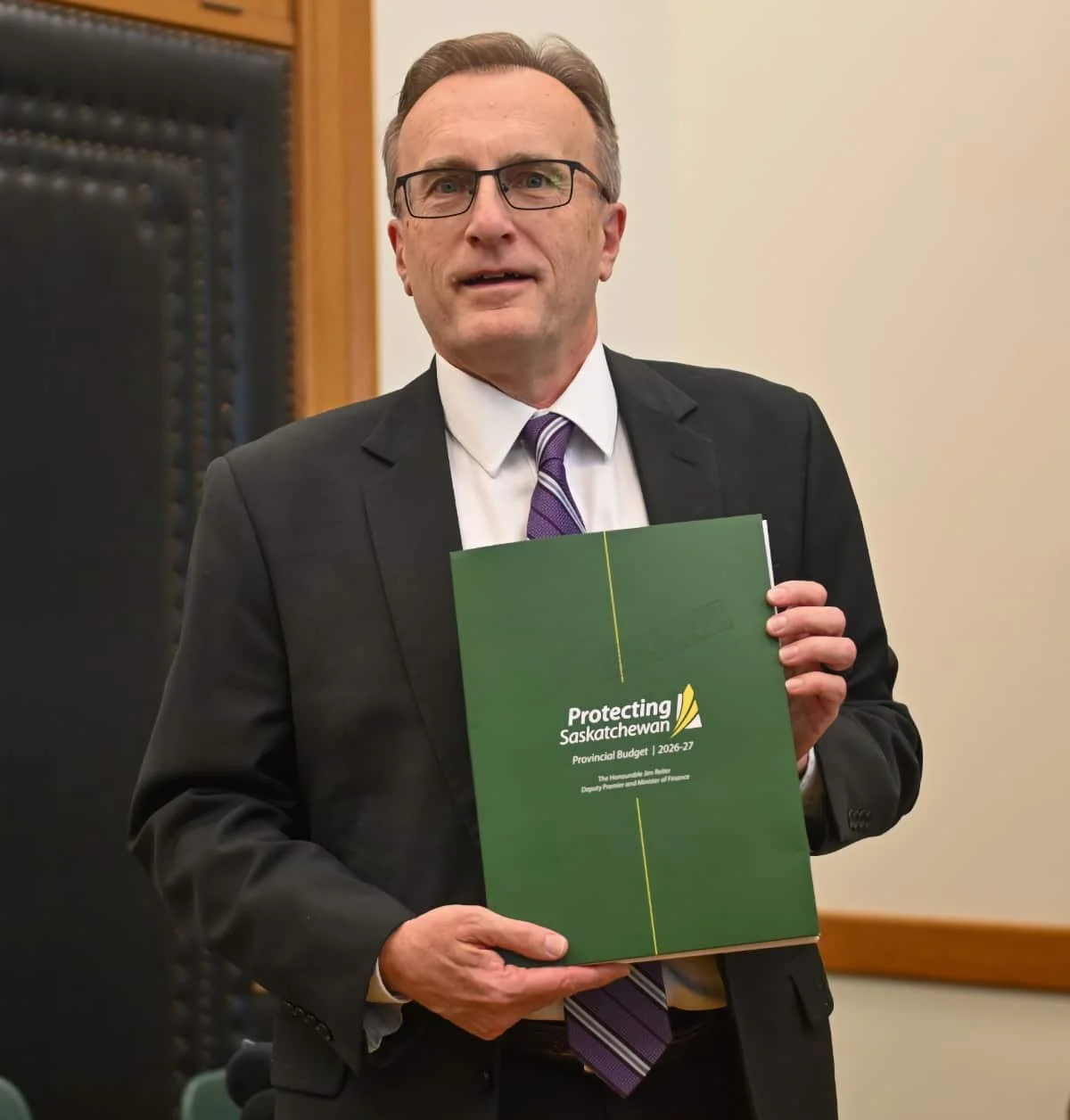
Minister of Finance and Deputy Premier Jim Reiter, with his second budget on March 18, 2026. Government of Saskatchewan photo
The budget pegs WTI at US$59.75 per barrel. That’s down $11.25 from the US$71 used in last year’s budget. Even that earlier number proved optimistic, with the current fiscal year now expected to average just US$61.69. Anyone in the patch knows the story. Much of the past year saw declining prices, dipping into the US$50 range before the recent spike.
That feeds directly into revenue.
The province is forecasting oil and natural gas revenue at $721 million, down $347 million, or 32.5 per cent, from last year’s budget. Lower prices and slightly reduced production are the main drivers, partially offset by a weaker Canadian dollar.
Production itself hasn’t shifted dramatically. Actual output for 2024-25 came in at 163.1 million barrels, or 446,849 barrels per day. The current fiscal year is now expected to land at 160.3 million barrels, while 2026-27 is forecast at 165.7 million barrels, or 453,973 barrels per day.
Small price swings matter.
Every US$1 change in WTI moves provincial revenue by about $16 million. If oil averaged roughly US$89.75, that would translate into an estimated $480 million in additional revenue. On the flip side, a one-cent increase in the Canadian dollar cuts revenues by about $42 million.
That volatility explains the province’s restraint. Even with prices currently elevated, the government is not building that upside into its plan.
The budget projects $21.4 billion in revenue against $22.2 billion in expenses, leaving a deficit of $819 million.
Deputy Premier and Finance Minister Jim Reiter pointed to global instability as the key risk.
“What keeps me up at night in the whole budget process is just the absolute volatility of world markets,” he said in a briefing, noting how oil moved from around $60 to near $100 in a matter of days.
The province’s approach is to limit reliance on non-renewable resource revenue to no more than 15 per cent of total revenue. This budget comes in at 11.5 per cent. If additional oil revenue materializes, Reiter said a significant portion would go toward debt reduction, though other pressures like health care remain.
Digging into the numbers
Non-renewable resource revenue is projected at $2.6 billion for 2026-27, about 12 per cent of total revenue. That’s down $132 million, or 4.9 per cent, from the previous budget.
The outlook depends heavily on external factors: global commodity prices, exchange rates, geopolitical developments, and supply chain stability.
Saskatchewan oil continues to sell at a discount to WTI due to its heavier quality. The budget assumes a stable light-heavy differential of 14.7 per cent, reflecting current pipeline capacity and market conditions.
Other resource revenues, including coal, minerals, and related fees, are expected to total $106 million, up modestly from last year.
The High Water-Cut Oil Well Program is extended to March 31, 2031. The program reduces royalties for wells producing at least 90 per cent water, helping operators manage higher costs and extend well life. The minimum investment threshold per well rises from $20,000 to $30,000.
Broader economic picture
Saskatchewan’s economy showed resilience in 2025, with exports reaching $43.5 billion despite weak oil prices and ongoing trade friction. That total was down four per cent from 2024, largely due to a $1.9 billion drop in energy exports.
Real GDP growth is estimated at 2.2 per cent for 2025, with 1.6 per cent projected for 2026. Over the medium term, growth is expected to average 2.3 per cent annually through 2030, driven by investment in natural resources and value-added agriculture.
Oil production is forecast to grow modestly, up 3.4 per cent in 2026-27 and averaging 1.1 per cent annual growth through 2030. Investment tied to improved pricing and pipeline capacity, including the Trans Mountain expansion, is expected to support that increase.
Globally, supply remains strong. OPEC+ continues to unwind production cuts, contributing to an oversupplied market and softer price expectations heading into 2026.
Energy and infrastructure spending
The province continues to invest in its resource sectors.
The Saskatchewan Geological Survey receives $2.3 million as part of a $10 million, 10-year Public Geoscience Initiative aimed at encouraging mineral exploration. Another $3.5 million goes toward the Targeted Mineral Exploration Incentive, which has helped Saskatchewan reach an estimated 17 per cent share of national exploration spending in 2025.
Crown corporation capital spending totals $2.5 billion for 2026-27. That includes $1.7 billion through SaskPower for generation and grid upgrades, $308.8 million through SaskEnergy for system expansion, and $539.1 million across other Crowns, including SaskTel investments in fibre and 5G.
Highways tied to oilpatch activity are also seeing upgrades. Work is planned on Highway 47 near Estevan, Highway 16 between Lloydminster and Lashburn, and several other key routes.
Bottom line
The current spike in oil prices could improve the province’s fiscal position. But the budget was built on a far more conservative foundation.
For now, Saskatchewan is planning for volatility, not betting against it.
This article is published with permission from Brian Zinchuk and is available at www.pipelineonline.ca. It has been edited for length.