
What happens in Ontario will have major impacts on Saskatchewan’s nuclear future
By Brian Zinchuk
PORT HOPE, ONT. – Just two weeks ago, Saskatchewan announced it was beginning the process to select a design for large-scale nuclear reactors in the 1,000-megawatt range. That decision will be closely tied to what happens in Ontario.
Ontario Power Generation (OPG) and Bruce Power have decades of nuclear experience and are both moving ahead with plans to add several large reactors. There is strong incentive for a fleet-wide approach across Canada: shared supply chains, training, operations, and fuel. And all of those reactors will likely be fuelled by Saskatchewan uranium.
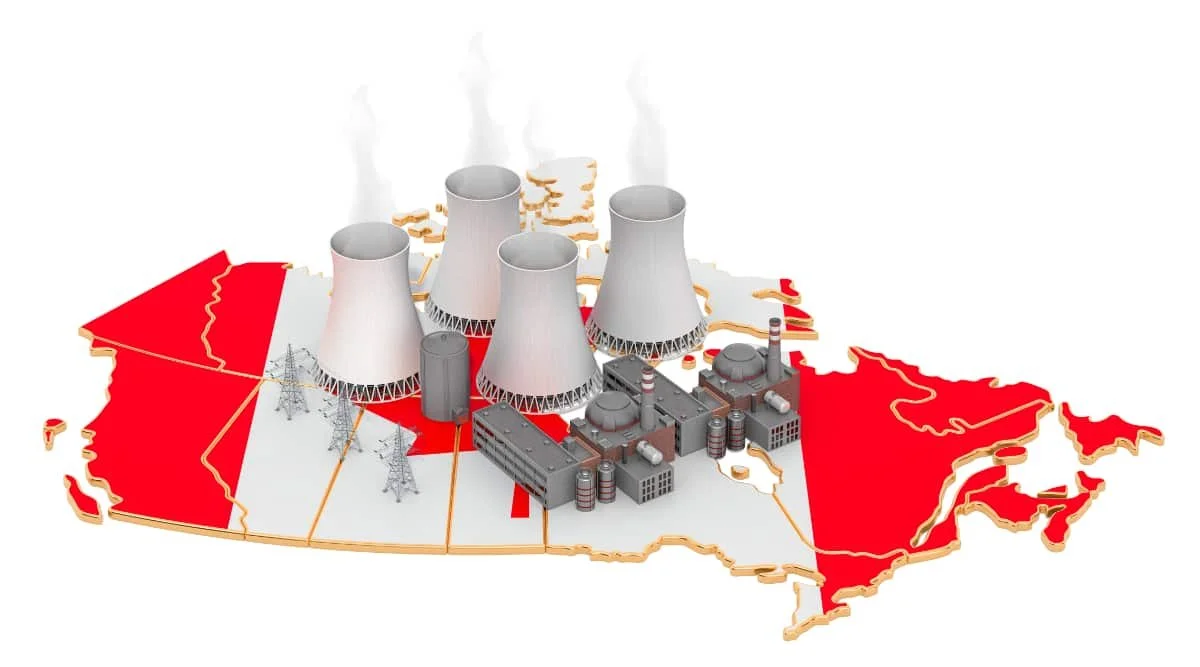
On Feb. 12, OPG and the Municipality of Port Hope signed a Memorandum of Understanding to advance collaboration on potential large-scale nuclear development at OPG’s Wesleyville site, eight kilometres west of Port Hope. The site hosted an oil-fired plant built in the 1970s that never fully operated. Not coincidentally, Cameco’s uranium conversion facility is in Port Hope — where Saskatchewan uranium is processed.
“Wesleyville is one of three sites, along with Lambton and Nanticoke, that OPG continues to explore opportunities with Rightsholders and local communities for potential new generation to meet Ontario’s forecasted increase in energy demand,” OPG said.
Potentially the largest nuclear power plant in the world
The scale is enormous.
According to the Impact Assessment Agency of Canada, the New Nuclear at Wesleyville Project could provide up to 10,000 megawatts of new nuclear capacity and operate for 78 years.
For comparison, Saskatchewan’s entire grid — with every hydro dam full, every coal and gas plant running flat out, and every wind turbine and solar panel at maximum — totals 6,125 megawatts. On many days, Saskatchewan uses around 2,800 megawatts. Even on peak days, demand typically sits near 3,500 megawatts.
In other words, Wesleyville at full build-out could power Saskatchewan three times over.
It would be one of the largest power generation sites on the planet, and the largest nuclear facility in the world — at least until Bruce Power potentially adds up to 4,800 megawatts at its Bruce C expansion.
Unlike wind and solar, nuclear plants routinely achieve their stated nameplate capacity, except during maintenance and refueling outages.
The 1,300-acre site is already zoned for generation, has transmission access, rail, road infrastructure, and sits on Lake Ontario for cooling water. It has been maintained for more than 50 years for future generation.
Geographically, Wesleyville would become the third nuclear station along the north shore of Lake Ontario, east of Toronto: Pickering, then Darlington, then Wesleyville.
OPG submitted its Initial Project Description to the Impact Assessment Agency of Canada in January, beginning a multi-phased federal review conducted with the Canadian Nuclear Safety Commission. The MOU includes $4.5 million in growth-readiness funding for Port Hope to prepare for the process.
Timelines measured in centuries
The proposed timeline is staggering.
Site preparation would begin in 2030. Construction in 2033. First operation in 2040. Final decommissioning of the last unit? 2160.
Each unit would operate for 70 years. Decommissioning would take 42 years per unit after shutdown. If Saskatchewan follows Ontario’s path, similar timelines could apply here.
Reactor designs under consideration
OPG has not selected a specific reactor and is using a Plant Parameter Envelope (PPE) approach. Technologies under consideration include:
Pressurized Water Reactors (PWR): Westinghouse AP1000, EDF EPR
Pressurized Heavy Water Reactor: AtkinsRéalis CANDU MONARK
Boiling Water Reactor: GE-Hitachi BWRX-300
SaskPower is examining many of the same large designs, though it has already selected the GE-Hitachi BWRX-300 for its initial small modular reactors.
Implications for Saskatchewan — and Canada
Whatever OPG chooses will heavily influence SaskPower.
Bruce Power is also studying up to 4,800 megawatts at Bruce C. If OPG and Bruce select the same reactor model, SaskPower will almost certainly follow. If they diverge — for example, one choosing CANDU and the other Westinghouse’s AP1000 — SaskPower faces a difficult choice.
Adding to the complexity, Energy Alberta has signed a collaboration framework with Westinghouse to explore building up to four AP1000 reactors in northern Alberta.
If a fleet approach is adopted nationally, Saskatchewan companies could potentially supply not just two reactors at home, but perhaps up to 18 units across Canada over coming decades. It would also mean common training and workforce development, with Saskatchewan and Alberta operators likely training in Ontario first.
The stakes for CANDU
For AtkinsRéalis, the stakes are existential.
The company acquired the CANDU reactor design from Atomic Energy of Canada Limited in 2011 for just $15 million after years without new sales. Its updated CANDU MONARK, launched Nov. 28, 2023, is a 1,000-megawatt design — but it has never been built.
Choosing MONARK would mean building a first-of-a-kind (FOAK) unit, with all the risks that entails.
Westinghouse’s AP1000, by contrast, has been built in the United States and China, though early builds were plagued by cost overruns that bankrupted Westinghouse. That bankruptcy led Brookfield Asset Management and Cameco to purchase the company, with Cameco paying US$2.1 billion for its 49 per cent share — less than the cost of a single AP1000 reactor.
If Canada adopts a fleet approach and it is not CANDU, the implications are serious. It would mean the Canadian-designed reactor could not even secure orders at home, severely dimming its global prospects.
Westinghouse, meanwhile, has international orders in Poland and Ukraine and would continue building abroad even without Canada.
The financial stakes
Each of these projects will likely be among the most expensive ever undertaken in their respective provinces. For Crown utilities like OPG and SaskPower, taxpayers ultimately stand behind the billions required.
Ontario’s government calls Wesleyville “the world’s largest nuclear generating station,” projecting 10,500 jobs and $235 billion added to provincial GDP over its lifespan. Minister Stephen Lecce said the plant would create “over 10,000 good-paying jobs and reliable power for up to 10 million homes.”
Ontario currently gets about 50 per cent of its electricity from nuclear and is planning for demand to rise sharply in the coming decades.
What Ontario decides matters
For Saskatchewan, this isn’t just an Ontario story.
It will shape reactor choice, supply chains, training pipelines, uranium markets, and potentially the future of the only Canadian-designed reactor technology.
If Canada moves as a fleet, the benefits could stretch coast to coast. If it fractures into competing designs, the decision matrix for SaskPower becomes far more complicated.
And in the case of CANDU, what Ontario decides may determine whether Canada’s homegrown reactor has a future at all.
PUBLISHER’S NOTE: This article has been edited for length to appear in this paper. You can read Brian’s full, unedited piece at www.pipelineonline.ca. Stories from PipelineOnline.ca are used with permission.