
Two determined young, single women homesteaded near Kindersley
By Joan Janzen
Homesteaders crowded around the Saskatoon land office in the early 1900s, waiting to claim land, but the majority of those pioneers were men. It was difficult for women to claim a free homestead. To do so, they had to undergo a lengthy process to prove they were married, widowed, or had dependent children.
Around 1910, single women were permitted to homestead land if they could afford to purchase South African scrip (SAS). Instead of purchasing land outright, they bought scrip that allowed them to homestead 320 acres. However, they did not initially own the land. They had to abide by strict rules and regulations in order to “prove up” their claims under the watchful eyes of land agents and inspectors.
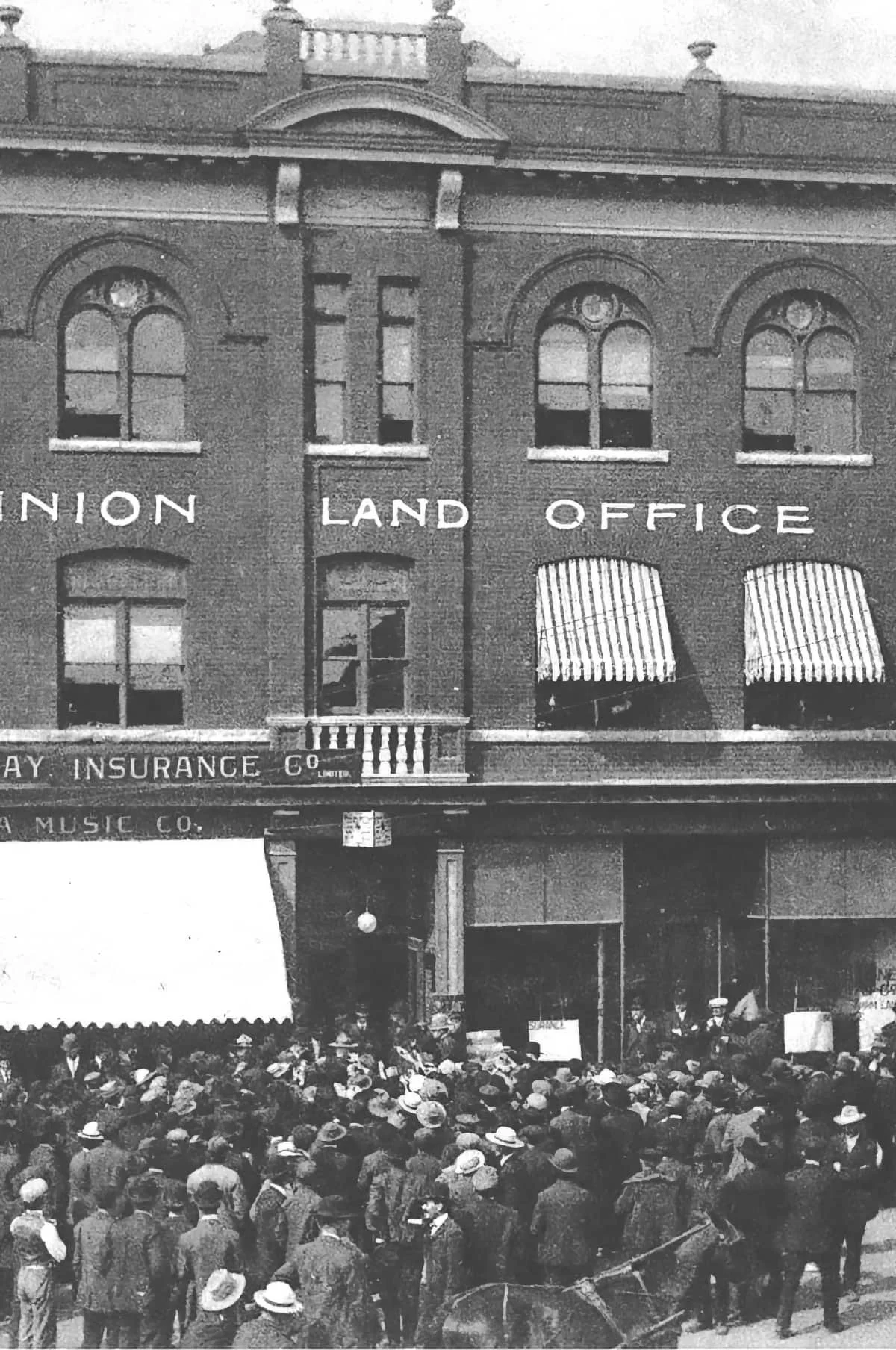
In the early 1900s, people rushed to claim free homesteads at land offices such as this one in Moose Jaw. However, single women who wanted to homestead faced many obstacles. In May 1910, Mildred Williams stood at the top of the stairs of the Saskatoon land office for twelve days and nights to file on 320 acres of land near Kindersley. She was not alone. That same year, Marie Westphal filed on land near Kindersley that had previously been abandoned by her brother. Photo: University of Alberta Libraries
According to Saskatchewan Archives Board (SAB) data, of the 4,730 SAS entries, only 11 percent were women. Here, we look at two of those determined single women who homesteaded land near Kindersley.
Mildred Williams was a teacher who made headlines across North America in May 1910 for her determination. Arriving from Minnesota, Williams supported her widowed mother but did not qualify for a free homestead because she had no dependent children.
After arriving in Canada, she worked as a teacher in Saskatoon. She was single, in her early 20s, and highly determined. That determination resulted in Williams waiting for twelve days and nights at the top of the stairs of the Saskatoon land office in order to file on 320 acres of land near Kindersley. The land was valued at between $18 and $20 an acre. It had previously belonged to a North-West Mounted Policeman who had received a land grant as an incentive to move west, but after serving in the Yukon, he returned to South Africa.
Mildred carefully planned her twelve-day vigil at the land office. She hired one woman to bring her meals and drinks, and another to act as a messenger. She rested in a reclining chair and even fashioned a tent above her at night.
There were reports of a man attempting to push her off her chair, at which point others came to her rescue. When she finally filed her claim, she was met with applause and cheers from waiting friends.
Williams successfully proved up the land and became an official landowner. However, she may have later sold the property, as the Star Phoenix reported that she resigned from her teaching position in 1917 and moved to the Pacific coast.
Another single woman who purchased South African scrip near Kindersley was Marie Westphal. In 1910, Westphal arrived from Milwaukee to the Eatonia area to keep house for her brother Herman, who was homesteading.
Marie filed on land that had previously been abandoned by one of her brothers, who had been unable to take up residence on it. Her father also homesteaded nearby. She later married and settled in the district, where the Westphal family accumulated additional land in the Kindersley area.
Information for this article was obtained from the University of Manitoba Archives.