
TMX 2? Trans Mountain 3? West Coast Pipeline to parallel existing Trans Mountain route, foregoing northern ports
By Brian Zinchuk
CALGARY—A new West Coast Pipeline project was announced on July 2, and it's a redux of the Trans Mountain Expansion -- the one that was supposed to cost $7.5 billion and came in closer to $34 billion.
Prime Minister Mark Carney and Alberta Premier Danielle Smith made the announcement in Calgary, where Smith submitted the province's proposal to the Major Projects Office, seeking a Project of National Interest Listing under the Building Canada Act.
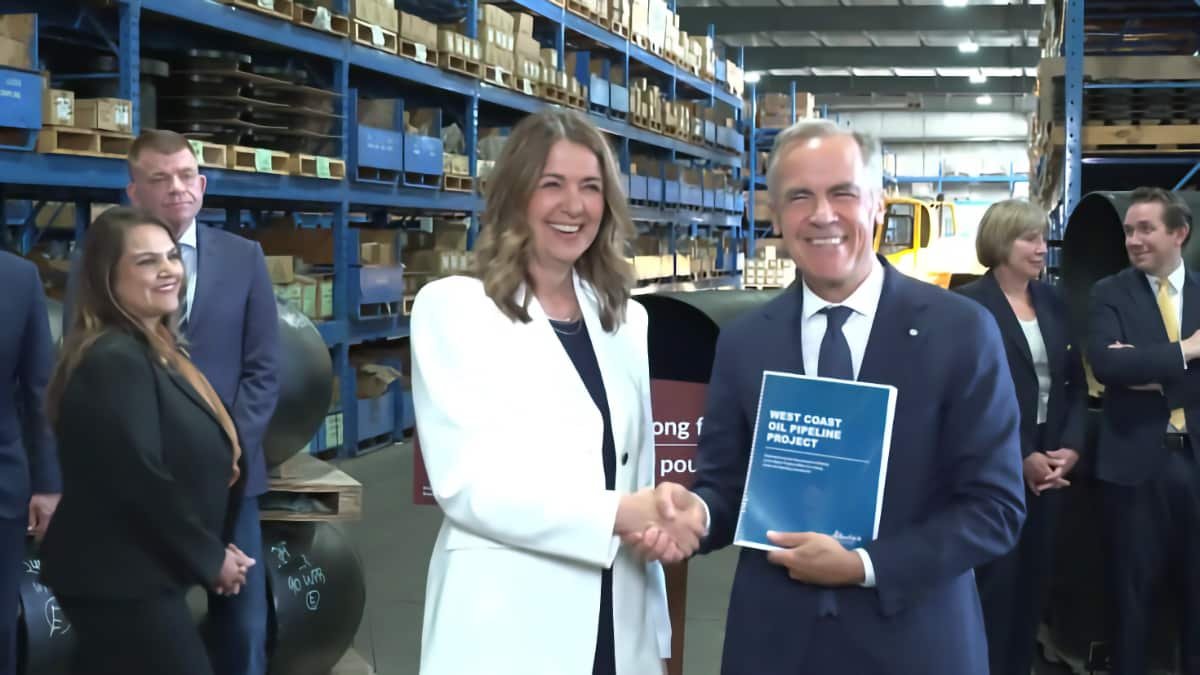
The pipeline is expected to transport more than one million barrels of oil per day to Canada's west coast and strengthen access to growing Asian markets, helping meet Alberta's goal to double its oil production to eight million barrels per day over the next 10 years.
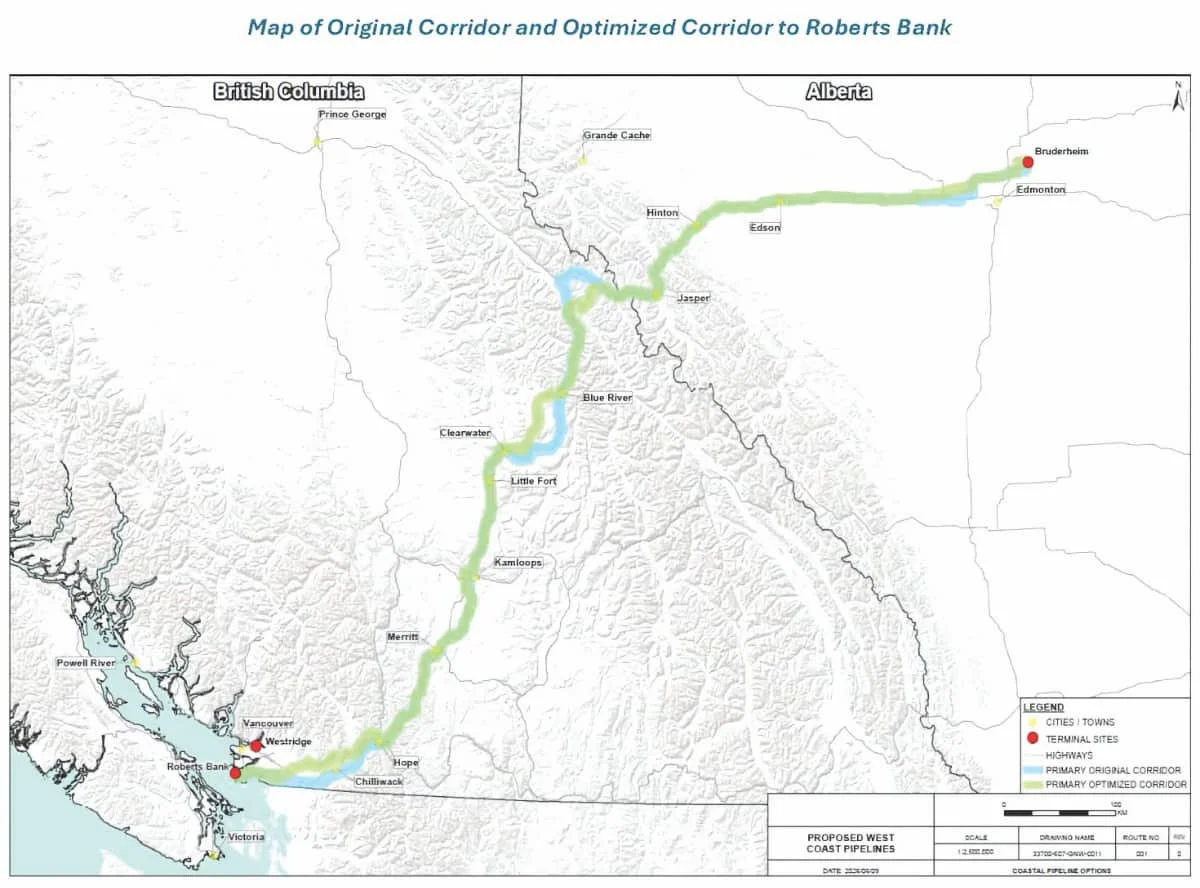
While previous indications from Alberta heavily favoured a northern British Columbia terminus at either Prince Rupert or Kitimat, the southern route to the Lower Mainland prevailed. Most of the Trans Mountain Expansion (TMX) route will be followed, except in the Lower Mainland. Instead of terminating at the Westridge Terminal in Burnaby, which has notable restrictions on tanker size, this new pipeline will end at Roberts Bank, at the extreme southwest corner of the mainland. This will allow supertankers -- known formally as very large crude carriers (VLCC) -- to load. It will be notably more distant from Asian markets than Prince Rupert or Kitimat. Ironically, Roberts Bank is also the main coal export terminal.
According to the application, the Bruderheim Receipt Terminal and Roberts Bank Delivery Terminal would each have 15 tanks with about 6.5 million barrels of storage capacity. The Bruderheim site will cover 50 to 60 hectares; Roberts Bank will cover about 260 hectares. The marine facility would include two loading berths capable of serving VLCCs carrying 1.9 to 2.2 million barrels per shipment, connected to shore by a jetty.
The map shows four areas where a new corridor is planned: west of Edmonton, just west of the BC/Alberta border, between Blue River and Clearwater, and from Hope to Roberts Bank.
Choosing the southern route allows the northern BC tanker ban to remain in place. The pipeline can be built without repealing Bill C-48, one of the "nine bad laws" Smith had flagged as restricting Alberta's oil sector.
The Government of Alberta noted early work construction may start as early as September 1, 2027, once Indigenous consultation is complete and all required approvals are in place. That is an extraordinarily short time frame compared to the defunct Northern Gateway and Energy East proposals, both of which failed as regulatory approvals dragged on and the goalposts moved.
This new pipeline, following the same route and paralleling the existing two Trans Mountain Pipelines, will have the advantage of recent experience along that right of way. It will also likely see a repeat of many of the challenges that made TMX so grossly over budget. There was no mention of projected cost at the press conference.
Canada and Alberta will be equal partners, with a meaningful equity stake reserved for Indigenous Peoples. Pembina Pipeline Corporation will be a private sector investor. Trans Mountain Corporation will plan and construct the pipeline.
Prime Minister's remarks
Carney called the day's combined announcements a "low ball figure," saying they "will catalyze well over $200 billion in direct investments in Canada, trade over 175,000 new jobs across the country, and we are just getting started."
He confirmed the federal government will maintain the tanker ban and announced that the Oil Sands Alliance -- the five oil sands companies — have agreed on terms to launch the Pathways Project, the world's largest carbon capture and storage project. That project, together with other emission reduction commitments, will achieve 16 million tonnes of emissions reductions per year, equivalent to taking 90 per cent of Alberta's cars off the road.
"Consultations will begin immediately with Indigenous communities, relevant provinces, and territories to determine listing under the Building Canada Act by October 1."
Carney also pointed to energy security as the driver: "There's an energy security issue today, and so the interest is how we move towards that." He noted LNG projects moving through Prince Rupert and Kitimat as part of a broader suite of Canadian energy solutions.
Premier Smith's comments
Smith described Alberta's oil reserves as valued at more than $9 trillion, saying development "would equate to hundreds of billions of dollars in government revenue" supporting health care, education, NATO commitments, and Indigenous economic prosperity.
After studying both northern and southern route options, Alberta selected the southern route from Bruderheim to a deep-water VLCC-capable port at Roberts Bank. "With the help of our technical advisory group, made up of industry experts, we determined that this route offers the fastest, most cost-effective path to expanding Canada's energy exports. Following the existing Trans Mountain pipeline corridor, this project builds on existing infrastructure, reduces regulatory barriers, given it would not be subject to the Oil Tanker Moratorium Act, and gets Canada's most valuable natural resource to global markets faster."
Asked whether the southern route traded commercial viability for political palatability, Smith said the two routes were "fairly comparable when it comes to the amount of dollars that would have to be outlaid, but you'd likely be able to build this one a couple or more years faster." The existing right of way, established Indigenous relationships, and reduced regulatory barriers drove the decision.
On government equity, Smith pointed to Northern Gateway, Keystone XL, and Energy East -- three projects where pipeline companies spent billions on regulatory processes before cancellations killed them. "It does take some work to make sure that the private sector proponents understand that this is a real process." She noted TMX has already returned over $1 billion in dividend payments to the federal government, calling completed pipeline infrastructure "incredibly lucrative."
Smith couldn't resist taking a shot at the previous Liberal government: "We've certainly come a long way from talk of phasing out Alberta's oil and gas, haven't we?"
Poilievre disagrees with start and end points
Conservative Leader Pierre Poilievre panned the plan, arguing the pipeline should begin at Hardisty and end at Prince Rupert or Kitimat. He called the northern tanker ban "ridiculous," noting American tankers carry Alaskan oil through the same Pacific waters routinely.
"It takes about 36 hours less time to get to Asia from northern BC than from southern BC because of the curvature of the earth. That's just simple geometry." Poilievre said the southern terminus risks routing oil toward California rather than diversifying into Asian markets.
Saskatchewan response
Saskatchewan will likely not see a single barrel of its oil enter this pipeline. However, as more Alberta crude flows west, it may free up capacity in the Enbridge Mainline and Keystone pipelines. The larger effect may be a further narrowing of the heavy crude differential versus West Texas Intermediate. TMX's opening in 2024 already pulled that differential down to the US$10 to US$12 range; previously it often rose to several times that, costing Saskatchewan hundreds of millions in lost royalties.
Premier Scott Moe had not responded by press time.
Saskatchewan NDP Leader Carla Beck said on social media that major energy decisions are being made without Saskatchewan at the table. "Ottawa is moving to build Canada from coast-to-coast with game-changing infrastructure, but the Sask. Party can't even produce a list of projects it's advocating for -- something we've been calling on them to release for 295 days and counting." The question now becomes when Saskatchewan comes to the table for its own bilateral development agreement with Ottawa.
Article edited down for length. Used with permission.