
SGI to harmonize service rig driver requirements with Alberta and eventually Manitoba
By Brian Zinchuk
WEYBURN – For a very long time, the Saskatchewan government has been working on reducing interprovincial trade barriers. Some of these are relatively inconsequential regulatory affairs that don’t sync between provinces, having been developed independently.
Way back in 2010, then-Premier Brad Wall brought together western premiers into the New West Partnership Agreement, which had a stated goal to “avoid measures that operate to restrict or impair trade between or through their territories, or investment or labour mobility between them.”
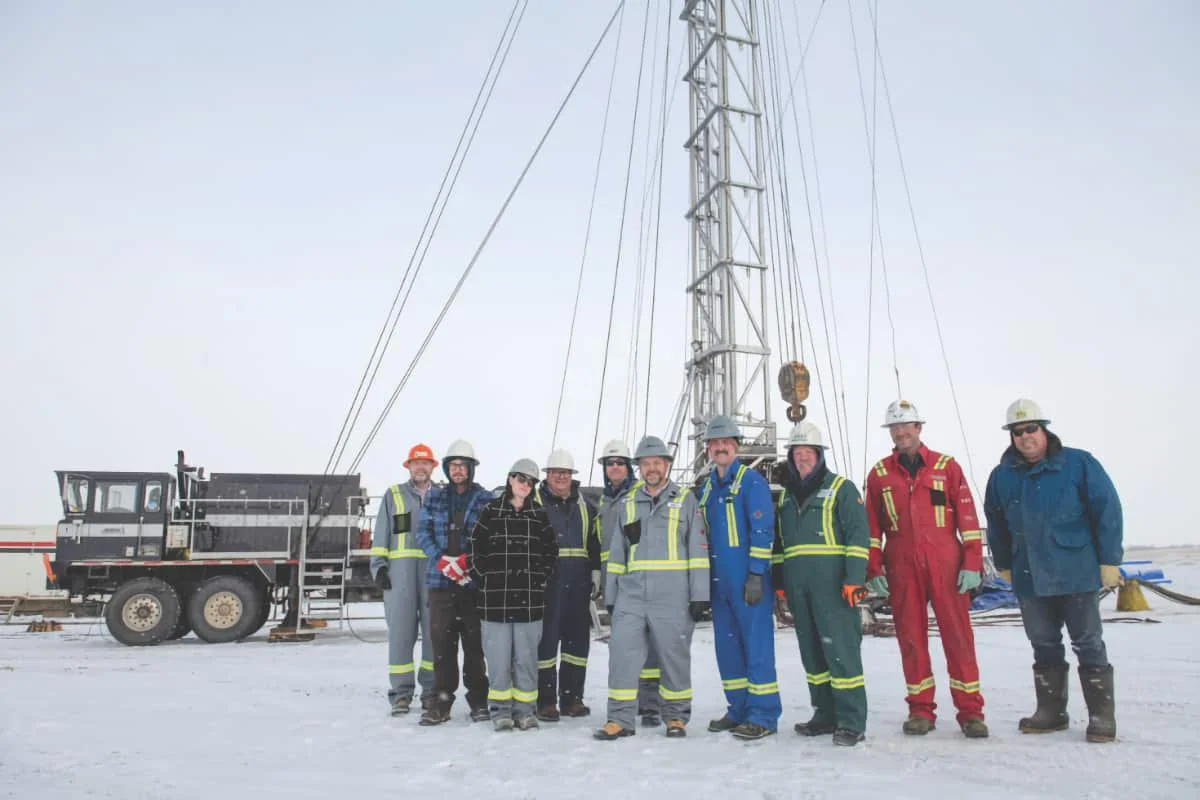
From left, unknown SGI rep, SaskBuilds Minister Sean Wilson, unknown SGI rep, Mike “Butch” Gering, Aaron Cugnet, SGI Minister Jeremy Harrison, CAOEC CEO Mark Scholz, Dennis Day, Mike Fowler, Estevan Mayor Tony Sernick. The photo was taken at an Aaron Well Servicing rig in the Viewfield area on Jan. 20. Photo by Brian Zinchuk
Sixteen years later, there’s still work to be done. And with the US-initiated trade war that’s been going on, Canadian provinces are again looking at reducing internal trade barriers which apparently still exist.
In this case, it’s SGI rules for service rig drivers.
That was brought forward on Jan. 20, when Minister of Crown Investments Corp. and Minister Responsible for SGI Jeremy Harrison met with president and CEO of the Canadian Association of Energy Contractors (CAOEC) Mark Scholz in Weyburn. There, in the offices of Aaron Well Servicing, they signed a Memorandum of Agreement.
Behind them were Mike “Butch” Gering of Diamond Energy Services, Swift Current; Aaron Cugnet of Aaron Well Servicing, Weyburn; Dennis Day of General Well Servicing, Ex-cel Well Servicing and Eagle Sky Ventures of Carnduff and Oxbow; and Mike Fowler of Eagle Sky Ventures, Carnduff.
Previously, Saskatchewan service rig drivers were required to get specific endorsements on their licence, and to submit periodic medical fitness reports, similar to drivers licensed to operate other heavy vehicles.
As of Jan. 20, amendments to The Driver Licensing and Suspension (Mobile Mounted Service Rigs) Amendment Regulations will:
Eliminate the G-Endorsement requirements for CAOEC member drivers.
Remove the requirement for CAOEC service rig drivers to submit periodic medical reports to SGI.
Service rigs spend approximately 95 per cent of their time performing well servicing operations, with very little time spent in transit. When they are on roads, they are driven in convoys, at speeds not exceeding 80 km/h, and largely on secondary or rural roads.
Service rig operators receive highly specialized training through a training program and certification process delivered by CAOEC, which is recognized by the provinces of Saskatchewan and Alberta.
The regulatory changes also harmonize Saskatchewan’s standards with those in Alberta. In 2019, the premiers of Saskatchewan and Alberta signed a memorandum of understanding to help remove provincial barriers to the movement of service rigs. This builds on harmonization work already underway, the government release said.
Scholz said the agreement is “a great day for service rigs in the province of Saskatchewan,” reducing red tape and promoting harmonization across Western Canada.
Harrison thanked the industry and said the change is about “creating the conditions where we have that harmonization, where we have that red tape reduced,” so service rig operators can do their job more effectively.
Asked what exactly this was all about, Scholz said it allows service rig contractors “to focus on what they’re good at, which is staying in the field,” while reducing administrative burden. He said the goal is harmonization with Alberta and eventually Manitoba, so contractors can operate under one set of transportation rules across Western Canada.
Scholz said the agreement is also meant to make movement between Saskatchewan and Alberta more seamless, particularly around Lloydminster, “where there truly is no border that exists between Alberta and Saskatchewan from a commerce perspective in oil and gas.”
Asked why it took so long to get to this point, Harrison said Saskatchewan is always looking for opportunities to harmonize regulation and remove trade barriers, including through bilateral agreements and the Canada Free Trade Agreement.
“I think in this circumstance now, we are going to have a situation where service rigs can operate under the same rules between Alberta and Saskatchewan,” Harrison said. “We’re working with Manitoba to get there as well.”
This article has been edited for length. The original can be found on pipelineonline.ca
Used with permission.