
Royalty break may be draining Saskatchewan oil revenues
By Brian Zinchuk
There’s something off in the 2026-27 provincial budget when it comes to oil revenue.
Yes, the numbers were clearly set before the Iran war drove prices upward. But that alone doesn’t explain what we’re seeing.
The budget forecasts oil and natural gas revenue at $721 million. That’s down $347 million, or 32.5 per cent, from the previous year. The province points to lower oil prices, a slightly worse differential and a stronger Canadian dollar.
But production? It’s essentially flat.
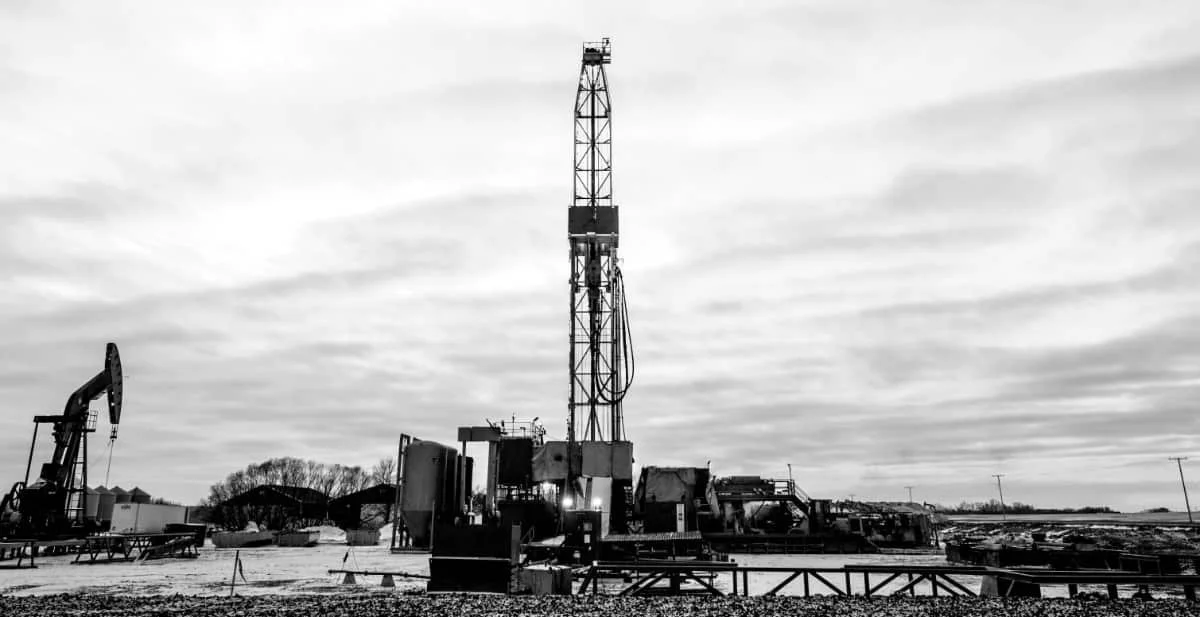
Most rigs working in southeast Saskatchewan this past winter were drilling multi-lateral wells, a shift that is reshaping both production methods and oilfield service activity. Photo by Brian Zinchuk
Actual production in 2024-25 was 163.1 million barrels. The current forecast for 2026-27 is 165.7 million barrels. That’s not a collapse. In fact, it’s slightly higher than what’s expected for the current year.
So how do you get a one-third drop in revenue on nearly the same production, with prices not falling nearly that much?
Something else is at play.
I’ve been warning for some time that the Multi-Lateral Oil Well Program could come back to bite the province. We may be seeing that now.
The program, introduced two years ago, was designed to boost production toward 600,000 barrels per day. Along with last year’s Low Productivity and Reactivation Program, it offered a powerful incentive: slash royalties from roughly 17.5 per cent down to 2.5 per cent on initial production.
For a fully utilized multi-lateral well, that means up to 100,600 barrels at the reduced rate. At $70 oil, that’s about $1.5 million in foregone royalties per well.
It’s no surprise the program took off.
In southeast Saskatchewan, most rigs are now drilling multi-lateral wells that qualify. And frankly, you’d be foolish not to. The royalty break can effectively pay for the well.
Great for producers. Great for drilling companies. Good for directional drillers.
Not so great for everyone else.
For years, a drilling rig in southeast Saskatchewan could drill four wells a month. That meant four jobs for surveyors, dirt movers, rig movers, casing crews, truckers, testers, service rigs and more.
Now?
A single multi-lateral well can take 23 to 42 days. Call it one well a month. That’s a 75 per cent drop in activity for a wide swath of oilfield service companies. Some are already feeling it hard.
There’s another issue.
Wells produce the most oil in their early months. That’s when governments typically collect the bulk of royalties.
But if that early production is taxed at just 2.5 per cent, the province is giving up most of that front-loaded revenue. And many wells never even reach the threshold where higher royalties kick in.
That creates a long-term problem.
We’re now two years into a four-year program. Production hasn’t surged. It’s flat. At best, these wells are offsetting natural declines.
Meanwhile, a growing share of production is coming from wells paying minimal royalties.
That’s a structural hit to revenue.
Higher oil prices, driven by global events, may temporarily mask the shortfall. But they won’t fix it. If anything, they highlight how little the province is capturing from each barrel under this system.
You don’t fund hospitals, schools or highways on 2.5 per cent royalties.
The government appears to be taking note. There are no new major incentive programs in this year’s budget.
The Multi-Lateral Well Program is halfway through its run.
It’s time to ask whether the trade-off made sense.
Brian Zinchuk is editor and owner of Pipeline Online. He can be reached at brian.zinchuk@pipelineonline.ca.
This article is published with permission from Brian Zinchuk and is available at www.pipelineonline.ca. It has been edited for length.