
By Brian Zinchuk, PipelineOnline.ca
In 2022, SaskPower selected the GE Vernova Hitachi BWRX-300 small modular reactor (SMR) because Ontario Power Generation (OPG) would build the same model first. Saskatchewan would then benefit from Ontario’s experience.
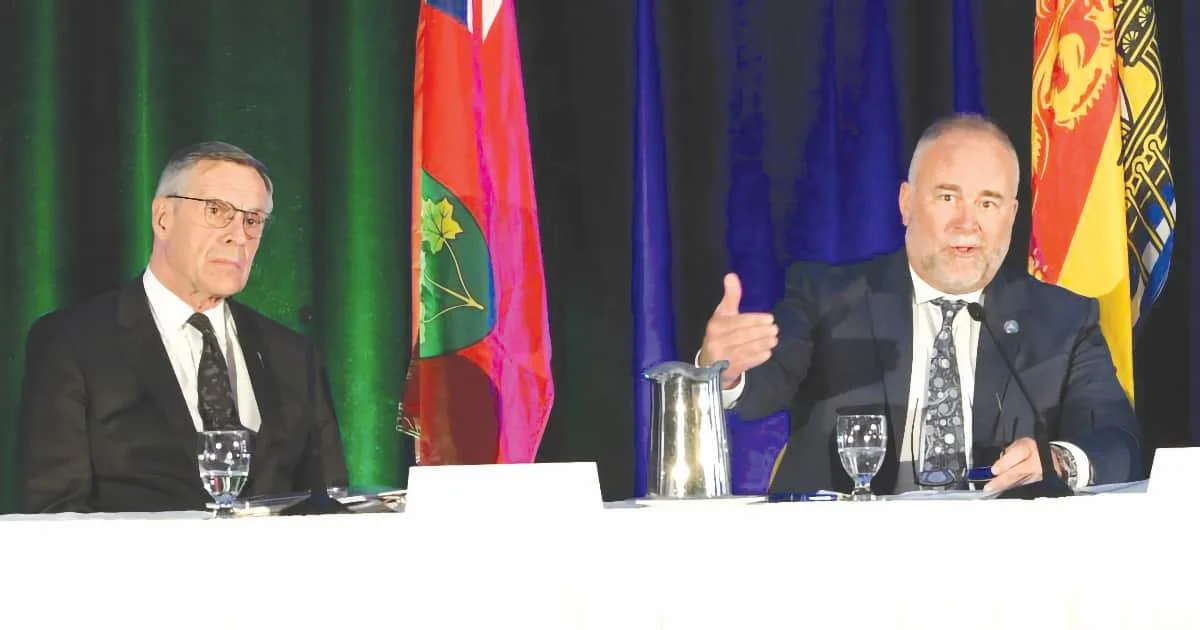
Then-SaskPower Minister Don Morgan, left, and then-Ontario Energy Minister Todd Smith at the nuclear announcement in Regina on Feb. 25, 2022. PHOTO BY BRIAN ZINCHUK
That plan just hit a snag. OPG’s third-quarter results, released Nov. 10, show its first unit is behind schedule and over budget.
In 2022, then-SaskPower Minister Don Morgan put the price of a small reactor in the range of $5 billion. Then-Ontario Energy Minister Todd Smith pushed back. “We don’t think it’s going to be nearly as high as you indicated,” he said.
Morgan said he would rather use a high figure and have it come in lower than face an overrun. “We’ll be watching carefully, as Ontario goes ahead, to make sure that the processes that they follow work well here,” he said.
In 2023, the first Darlington SMR was expected online in 2028. That would have given SaskPower one to two years of operating experience before committing. In spring 2025, Ontario greenlit four BWRX-300s at a total cost of $20.9 billion. OPG pegged the first-of-a-kind (FOAK) unit, including $1.6 billion in common infrastructure, at $7.7 billion. That left $4.4 billion for each of the three Nth-of-a-kind (NOAK) units.
Eighteen months later, those numbers no longer hold.
OPG’s Q3 report said Darlington Unit 1 is no longer expected to meet its October 2030 commercial operation target or come in at $7.7 billion. OPG pointed to GE Vernova Hitachi’s ongoing engineering for its first-of-a-kind design, which is affecting construction and the supply chain. A full cost and schedule assessment is expected to be substantially complete by mid-2027.
The project has hit milestones. Crews installed the 2.1-million-pound basemat, the first nuclear foundation laid in Canada in more than 30 years. The tunnel boring machine is assembled, with tunnelling set to begin this quarter, and the first turbine building pour is complete.
“At the same time, we have identified risks that will impact Unit 1’s schedule and budget,” said OPG president and CEO Nicolle Butcher. “As we continue construction, we are working to fully assess those impacts, and establish mitigation measures and a cost and schedule outlook that we can stand behind.”
The first reactor was always expected to cost more than the ones that follow.
We’re engaged, but haven’t said “I do” yet
SaskPower has selected the BWRX-300 and is working through licensing, but nothing is firm until a final investment decision. Saskatchewan may be engaged to GEVH’s BWRX-300, the venue announced and save-the-date cards sent, but we have not yet said “I do.” And there is still a chance we end up marrying the possibly better-looking maid of honour instead.
The province is looking at two 300-megawatt-scale reactors west of Estevan on the Rafferty Reservoir, announced Sept. 29 in Saskatoon. Premier Scott Moe also said the province is looking at two 1,000-megawatt-scale reactors on the North Saskatchewan River in northwest Saskatchewan. Technology selection for the large reactor design began in January.
For years, the final investment decision was expected in 2029, with construction in 2030 and first power to the grid around 2034-35. In an Oct. 16 Pipeline Online podcast, three weeks before OPG’s announcement, Minister Responsible for SaskPower Jeremy Harrison said that timeline will slip.
“The fact that we’ve had multi-year delays at Darlington on the OPG SMR project will mean that we will not be in the position to make a decision on the time frame which it had been first laid out,” Harrison said.
He said the province needs cost certainty and to know what an Nth-of-a-kind unit will cost before comparing it with large-scale nuclear. Site licensing at Rafferty continues regardless.
That leaves room for the maid of honour. The Estevan-area site could host a large reactor instead, possibly one identical to the two planned for the northwest. That would give Saskatchewan a common fleet rather than a mix of SMRs and large reactors.
“We’re keeping an open mind on potentially large scale in the Estevan region as well,” Harrison said.
Article edited down for length. Used with permission.