
NDP releases Pembina paper pegging coal refurbishment at $32 billion
By Brian Zinchuk
PipelineOnline.ca
REGINA – On Aug. 24 the Saskatchewan NDP released another paper suggesting sky-high costs should Saskatchewan proceed with planned refurbishment of its coal-fired power generating fleet.
The paper was published by the Pembina Institute and entitled Burning Questions: How Saskatchewan's coal extension impacts affordability, reliability and a modern electricity grid. It was authored by Nina Logvin and Will Noel. Notably, it quotes CBC eight times, CTV twice, and Pipeline Online zero times, despite this publication doing more in-depth coverage of this issue than all other Saskatchewan media.
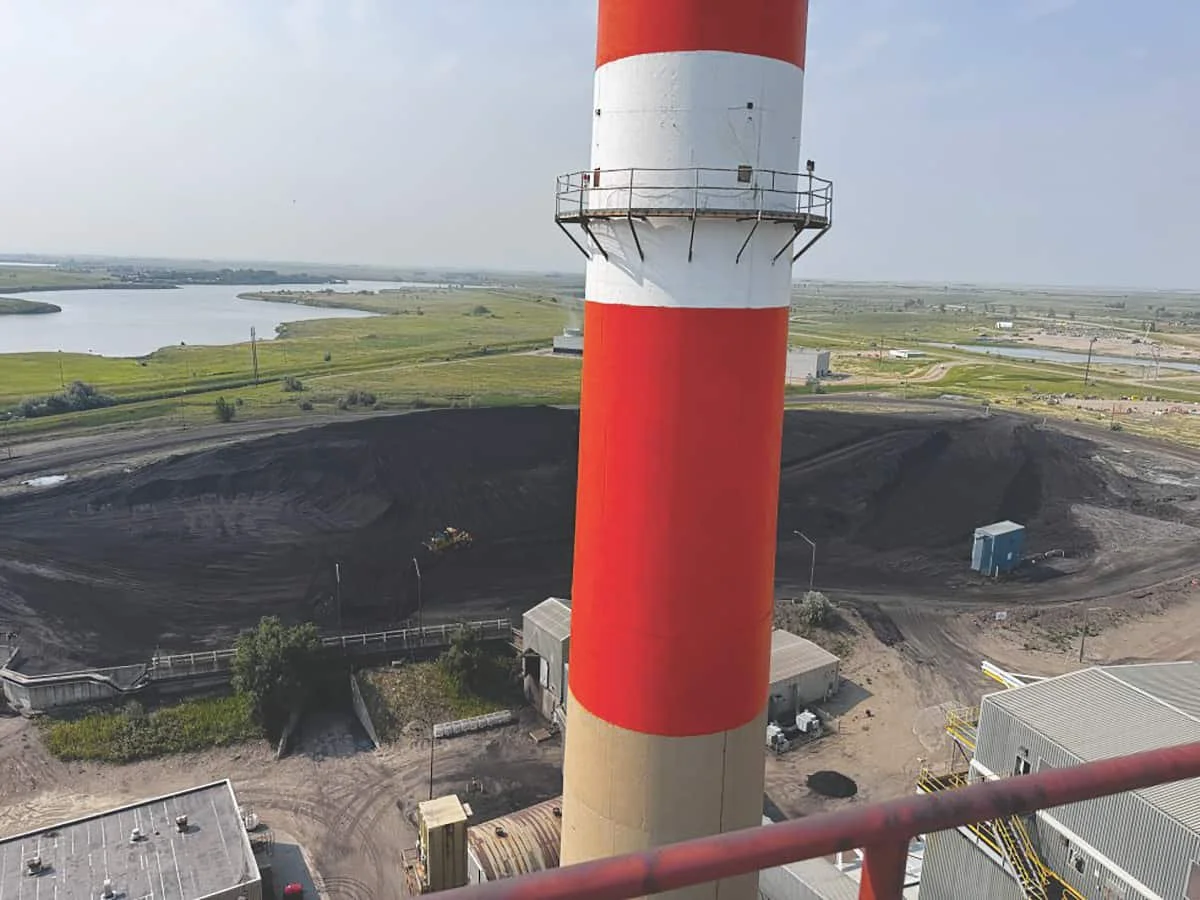
Looking down at the coal stockpile from the roof of Boundary Dam Power Station. Photo by Brian Zinchuk

Minster Jeremy Harrison at Boundary Dam Power Station. Photo by Brian Zinchuk
Shadow Minister of Environment Jared Clark said in a press conference the Pembina number lands at $32 billion, on top of a CD Howe Institute report pegging refurbishment at $46 billion and SaskPower internal documents at $26 billion.
"Again, this is the most expensive option that the Sask Party could be choosing when it comes to powering Saskatchewan in the future," Clark said. He added the report warns of health implications from continuing to burn coal, putting that cost at $160 million to the provincial health care system.
"The only way to stop this catastrophic coal plan is to change the government.”
Minister responds
Minister of Crown Investments Corporation and Minister Responsible for SaskPower Jeremy Harrison responded by email, saying the events of the past week are another reminder of why energy security matters.
"At the center of our Energy Security Strategy is producing power by using Saskatchewan's resources of today as a bridge to using Saskatchewan's uranium resources for tomorrow. The government will not accept the NDP's plan of dependency on other jurisdictions, like the United States, to keep the lights on."
He said the province is taking an all-of-the-above approach, extending the life of existing thermal assets while adding renewables, advancing nuclear and strengthening transmission.
"This is about making practical decisions based on reliability and cost, not rebuilding Saskatchewan's electricity system around ideology like advocated by far left academics, think tanks, and the Saskatchewan NDP.”
What the paper says
Pembina's core finding is that refurbishing and operating the coal fleet to 2050 costs $26 to $32 billion, including refurbishment, fuel, operations, maintenance and financing. Converting the fleet to burn natural gas comes in at $18 to $25 billion. Expanding wind and solar to displace 25 years of coal-fired supply lands at $12 to $17 billion, plus roughly $1 billion in batteries.
The paper also says extending the coal phase-out by 20 years would release an additional 155 megatonnes of greenhouse gases, comparable to the annual emissions of the Netherlands.
Its recommendations: get back on track for a 2030 coal phase-out, require SaskPower to model supply scenarios at lowest cost to ratepayers, and have Ottawa refuse any equivalency agreement without a short-term coal phase-out pathway.
Renewables
The paper lays out a scenario using data from five days in early November, suggesting wind and solar, with batteries, could keep the lights on here.
But November does not typically see the worst extremes for temperature or lack of wind. That usually occurs from late December into late February. What the Pembina scenario does not reflect is the harshest part of winter, or periods like January 2024, when Pipeline Online reported that for seven days in a row, SaskPower saw wind generation hit zero output for part of the day.
On May 16, 2023, SaskPower president and CEO Rupen Pandya said, "SaskPower currently has 617 megawatts of wind generation and on the hottest or coldest days of the year, when demand for electricity is that it is at its highest, there's often very little wind for days at a time."
The three Pembina scenarios add either 4,375 MW of wind, or 3,400 MW of wind with 1,700 MW of solar, or 2,818 MW of each. Batteries are pegged at either 250 or 1,100 megawatts of capacity, for four hours.
Alberta has already built 5,684 megawatts of nameplate wind and 1,892 megawatts of nameplate solar. That is substantially more wind than Pembina suggests in all three scenarios, and more solar in two of them.
At the time of writing, 1 a.m. on Aug. 25, Alberta's total wind output was 172 megawatts and solar was zero. The sun went down four hours ago, meaning the suggested four-hour battery would be fully depleted right now. Over the previous three hours, Alberta pool prices ran from $930 to $962 per megawatt-hour, within spitting distance of the theoretical maximum. Dispatchable and baseload generation kept Alberta going through the night.
Closer to home, on Aug. 12, 2026, Saskatchewan wind output averaged just 11 megawatts over 24 hours out of a nameplate capacity of 817 megawatts, according to SaskPower's Where Your Power Comes From page as logged by X account @SkElectricity. On that day alone, all three Pembina scenarios would have seen the four-hour batteries depleted six times over, assuming instant recharging, which is impossible.
Emissions and geography
The report notes Saskatchewan has an outsized share of Canada's power generation emissions because it burns coal. It says this without the context that unlike Manitoba, British Columbia, Ontario, Quebec and Newfoundland and Labrador, Saskatchewan has neither large amounts of water nor substantial elevation change. It does have coal.
Consider the North Saskatchewan River. It enters the province north of Lloydminster at 497 metres and leaves near The Pas at 270 metres. That is a drop of 227 metres, and you could fit the entirety of Germany between those two points. The Churchill Falls Generating Station in Labrador has roughly 312 to 322 metres of head. One site has more elevation change than the entirety of Saskatchewan's most important river.
Baseload
The report is dismissive of baseload, calling it a legacy of how grids used to be designed and not a physical requirement for keeping the lights on. It argues large, centralized, inflexible plants are becoming a liability, pointing to the 2023 Poplar River flooding and Alberta's 2017 loss of a third of its coal capacity to high temperatures.
Its conclusion is that system flexibility, not baseload, will keep the lights on. The figure presented as the future grid all but does away with baseload, with variable generation making up the vast majority.
The methodology includes 20 years of interest payments on refurbishment of individual units, calculated at an 8 per cent weighted-average cost of capital.
Article edited down for length. Used with permission.