
Memories of prairie childhood shared by Eatonia seniors
By Joan Janzen
EATONIA — Two residents of Eatonia Oasis Living recently shared stories of growing up on the prairies, offering a glimpse into rural life from nearly a century ago.
Ted Douglas, 101, and Glenn Woodrow, who recently turned 87, reflected on childhood memories that together span 188 years of prairie history.
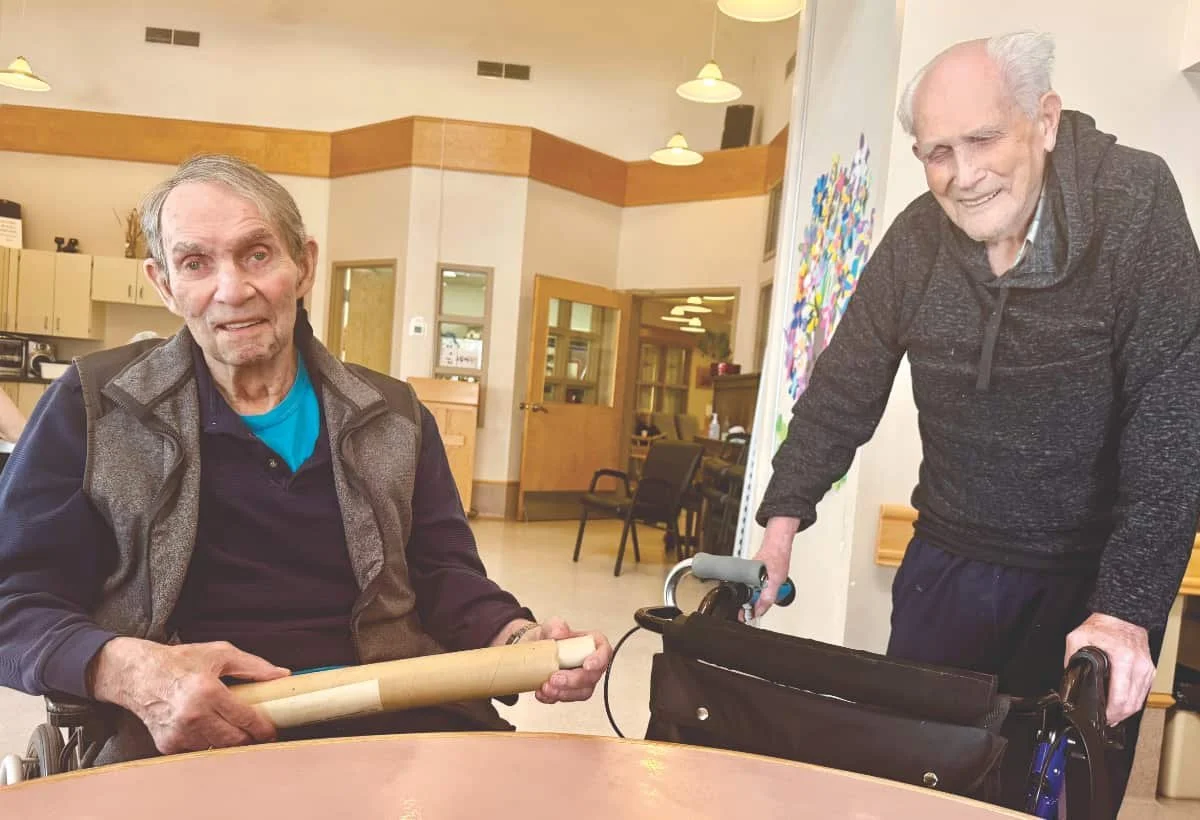
Glenn Woodrow, 87 (left), and Ted Douglas, 101, shared memories of growing up on the prairies. Both men reside at Eatonia Oasis Living.
Douglas was born Dec. 31, 1924, in Empress Hospital in Alberta and grew up on a farm between Empress and Eatonia with his three younger siblings. When asked where the farm was located, he quickly recited the land description. Woodrow laughed and translated it more simply: “It’s out in the middle of nowhere.”
Woodrow was born in 1939 at Laporte, where his father worked as a grain buyer. He grew up with two sisters in what he recalls as a thriving small community with a couple of stores, a hospital and a one-room school that taught Grades 1 through 9.
Children in those days had few toys, but they still found plenty to do.
Woodrow remembered a wagon his father built for him in the elevator shop. His grandfather, an avid fisherman, also introduced him early to fishing trips and berry picking.
Douglas said he often received mechanical toys because of his father’s interest in machinery. One Christmas gift in particular still stands out.
“I remember getting a train that you wound up and ran on a track,” he said. “I remember it like it was yesterday.”
Winter recreation often meant skating on nearby sloughs. Woodrow used bob skates strapped onto his shoes, while Douglas borrowed his mother’s skates until he later bought his own.
School life also left lasting memories. Douglas recalled that his first teacher was Max Braithwaite, who later became a well-known writer and author of Why Shoot the Teacher. At the time, many of Douglas’s classmates were German-speaking, and German was taught in school.
His early school years coincided with the drought of the Dirty Thirties.
“I remember one particular dust storm — from the ground up it was a wall of dust,” Douglas said. “When it hit, you couldn’t see across the yard.”
Woodrow, though born near the end of the decade, still remembered its aftermath.
“I remember snowbanks that were made out of sand, and the ditches were full of sand,” he said.
Life on the prairies also meant adapting to simpler household routines. Baths were often taken in a tub in the kitchen near the stove for warmth. Outhouses were used in summer, while a portable commode was brought indoors during winter.
Both men remembered radios powered by windmills or batteries that were sometimes charged using a car generator.
Community life often revolved around music and dancing. Woodrow recalled dances at the Laporte Hall, where his grandfather had installed the dance floor.
“It was the best dance hall around,” he said. The hall is now designated as a Municipal Heritage Property.
As boys, both men also worked small jobs. Woodrow delivered groceries for $3 a week, while Douglas arrived early at school to stoke the coal furnace.
Douglas eventually left school after Grade 9 when his rural school closed and attended a technical school in Saskatoon before joining the Air Force as a machinist. Woodrow also left school after Grade 9 and took a carpentry course in Moose Jaw.
Today the two men share meals and conversation at Eatonia Oasis Living.
“I sit beside you at every meal,” Woodrow told Douglas during their conversation. “But I think I learned more about you today.”
Their memories offer a reminder of the hard work, humour and resilience that shaped prairie life for generations.