
German pioneers blazed a trail to Luseland
By Joan Janzen
According to a contribution submitted to Historic Saskatchewan’s Facebook page, Volga German settlers built a new church in 1910. Volga German settlers were Germans who came from the Volga region of Russia. Perhaps someone can tell us the name of this particular church.
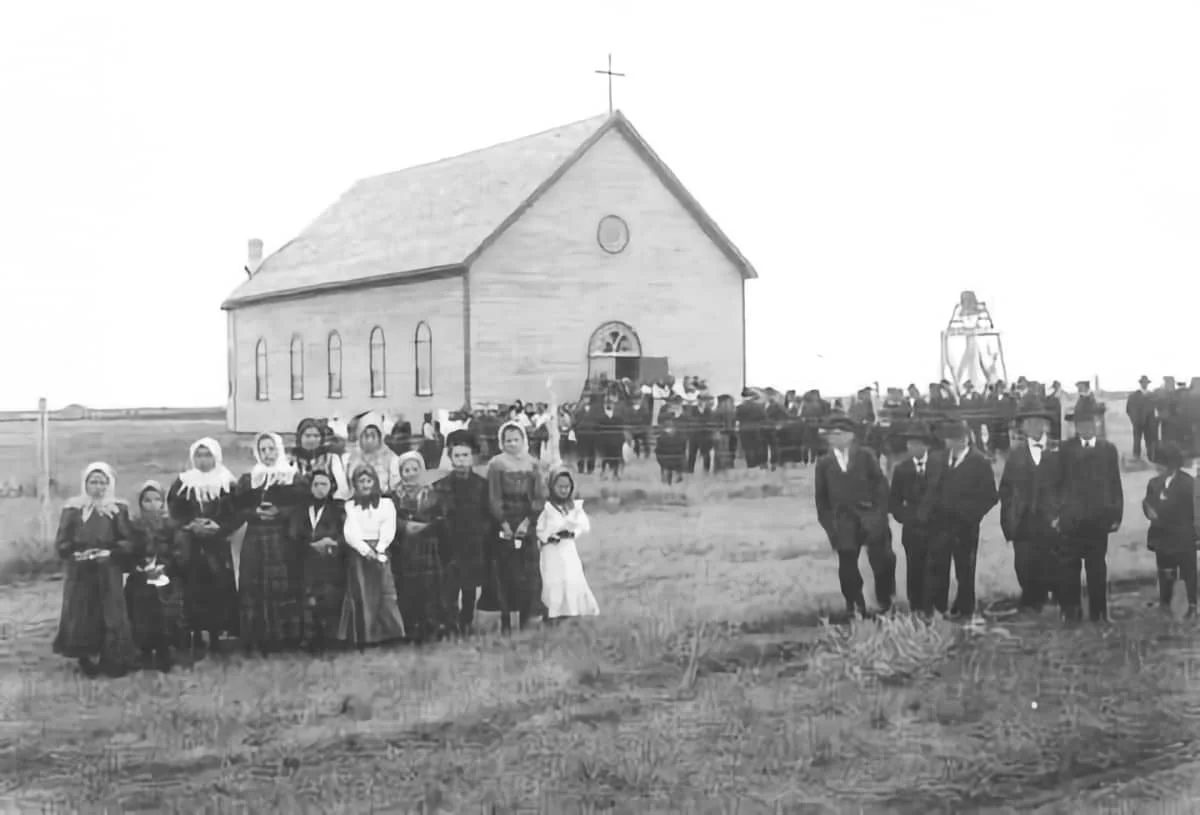
In 1910, early Volga German settlers stand beside a newly built church near Luseland, Sask. Volga German settlers are Germans who came from the Volga region of Russia. Notice how the women and children are standing together on the left, and the men and boys are on the right. Photo: Historic Saskatchewan
The book German Settlements in Saskatchewan describes the historical formation of German settlements in the province. Approximately 7,000 Mennonites from Russia, who had lost their military exemption, blazed a trail to Canada between 1874 and 1879. More than half of western Canada’s 152,000 German pioneer settlers came from Eastern Europe. Numerous German settlements were developed by German Catholics and Protestants from South Russia, which is part of present-day Ukraine.
Germans from Russia were a minority population in Russia, Ukraine, and the Soviet Union, and they arrived in several waves. As a consequence of Russification policies and compulsory military service in the Russian Empire, large groups of Germans from Russia emigrated mainly to Canada and the United States, as well as to Brazil and Argentina, where they founded many towns.
Many Canadians of German descent have great-grandparents who came to Canada from Russia in the late 1800s as a result of the changes happening in Russia at the time. Consequently, people of German ethnic origin comprise a significant portion of Saskatchewan’s population.