
Enbridge puts Line 26 project on indefinite hold, with major implications for Saskatchewan
By Brian Zinchuk
PipelineOnline
CALGARY – Over the past several months there has been a near-constant stream of export pipeline announcements, a half-million barrels here, a million there, all leading to the inevitable question. Will there be enough oil production to fill these new pipelines?
That question was answered, for now, when Enbridge released its first half financials on July 31. The 500,000 barrel per day Phase 2 of its Mainline Optimization Project, which heavily involved southeast Saskatchewan, has been put on indefinite hold.
That is according to Enbridge spokesperson Gina Sutherland, speaking to Pipeline Online that day.
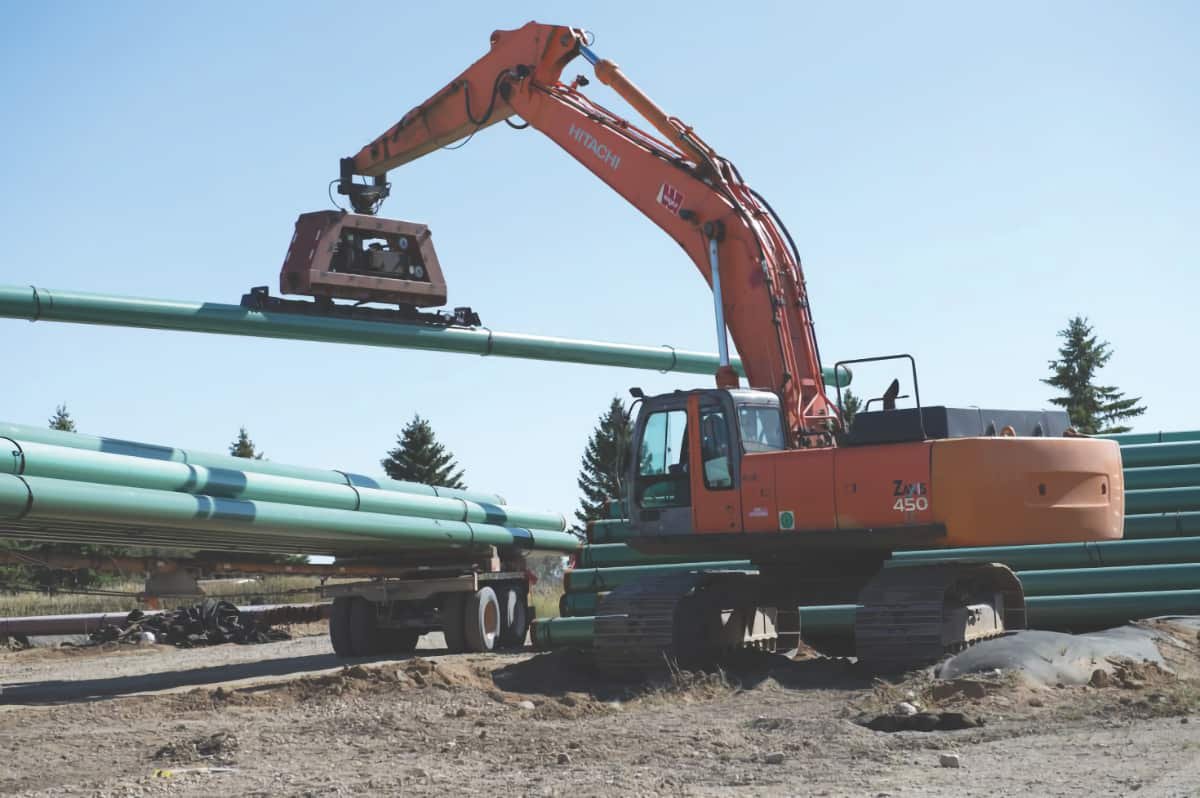
On Sept. 12, 2012, Enbridge was building its Bakken Expansion Project, now Line 26. That project would have figured heavily into its second phase of its Mainline Optimization Project, now on indefinite hold. This photo was east of Redvers. Photo by Brian Zinchuk
In an emailed statement, Enbridge said the Line 26 Optimization project is on hold as part of a broader resequencing of Mainline Optimization Phase 2 opportunities, with priority shifting to expansions on its downstream pipelines running from Chicago south to the U.S. Gulf Coast. In the near term the company is focused on advancing expansions of Flanagan South and Southern Extension. Enbridge added that the policy environment needs to change to give producers the confidence to invest in growth, and while it is optimistic about some of the changes proposed so far, implementation will take time. The company said it remains confident in the long-term need for incremental Mainline capacity.
One of many projects
The half-million barrel per day project was facing competition from several others now in the works, each of them a rehash of a previous project.
The 550,000 bpd Bridger Pipeline Expansion would take parts of Keystone XL already built and in the ground in Alberta, complete it through Saskatchewan, then turn south to a new destination at Guernsey, Wyoming, instead of the KXL terminus of Steele City, Nebraska. President Donald Trump granted a presidential permit for that project on April 30, for a 36-inch pipeline.
Then there is the West Coast Pipeline, another expansion of the Trans Mountain system, adding a third pipeline that would largely follow the route of the recent Trans Mountain Expansion. Announced in early July, it is slated for a million barrels per day.
A few days later came a heavily modified redux of Energy East. The Northern Shield Energy Corridor would parallel the Enbridge Mainline from Hardisty to Regina, then the TC Energy Mainline from Regina to eastern Ontario, before hooking around the Great Lakes to Sarnia. The half-million barrel per day proposal would free Ontario from its dependence on Enbridge's Line 5, which has been under considerable pressure from the State of Michigan over its crossing of the Straits of Mackinac.
Those three projects add just over two million barrels per day of takeaway capacity, almost all of it for increased Alberta production. Northwest Saskatchewan could feed either Bridger or Northern Shield, as much of that region's oil finds its way to the Hardisty terminal.
The fourth project, Enbridge's Phase 2, would have added another half million barrels per day and dramatically changed the flow of oil in southeast Saskatchewan, as well as adding potential takeaway barrels for all Saskatchewan production. It quietly received its presidential permit on April 15, covering a 24-inch line crossing the border near Portal, North Dakota.
What Line 26 is now
Line 26 was built in 2012 as the Bakken Expansion Project, designed to move North Dakota oil, then mostly shipped by rail, north into Saskatchewan and on to Manitoba, where it joined the Mainline heading to Superior, Wisconsin. It is a 12-to-16-inch crude oil pipeline running 261 kilometres from Berthold, N.D., to Cromer, Man., with an average annual capacity of 145,000 barrels per day of light crude.
The optimization project would have reversed that flow, sending product north to south, and connected Line 26 to an Energy Transfer facility with access to the Dakota Access Pipeline.
Enbridge would have kept operating the existing 16-inch line from Cromer to the Steelman pump station in Saskatchewan, then built a new 24-inch segment from Steelman across the border to the Ramberg Terminal in North Dakota. That segment would have run about 128 kilometres, roughly 32 in Saskatchewan and 96 in North Dakota. The existing 12-inch line south of Steelman would have been decommissioned or abandoned. The work also called for a new pump station at Cromer, a new midpoint station near Alida, Sask., and equipment modifications at Steelman.
Enbridge had planned to decide by mid-2026 whether to proceed, file regulatory applications in the second half of the year, begin construction in 2027 and 2028, and put the line in service by late 2028.
The project page was removed from Enbridge's website on July 31.
Pipeline Online has been working on a major story detailing the implications of the project, and those developments will now require major revisions.
Enough work has been done that the project could be revived at a later date. If it is, it would be the largest change in the marketing of Saskatchewan oil production since the province started producing in quantity.
Article edited down for length. Used with permission.