
Alberta wind fleet drops to zero output for 52 minutes amid prolonged lull
By Brian Zinchuk
For 52 minutes straight, Alberta’s 1,760 wind turbines produced precisely zero power the morning of Saturday, Feb 21, and next to no power for 27 hours straight, and counting.
Those 1,760 wind turbines, collectively costing billions of dollars, could not charge a singular cellphone during those 52 minutes.
That’s according to minute-by-minute data published by the Alberta Electric System Operator, or AESO.
For those 27 hours, Alberta’s wind generation fleet output flatlined, with single-digit output from a nameplate capacity of 5,684 megawatts for much of that period. Several hours saw output numbers of 1, 2, and 3 megawatts, while other hours saw zero.

Albera Wind Turbine. Photo by Clive Schaupmeyer
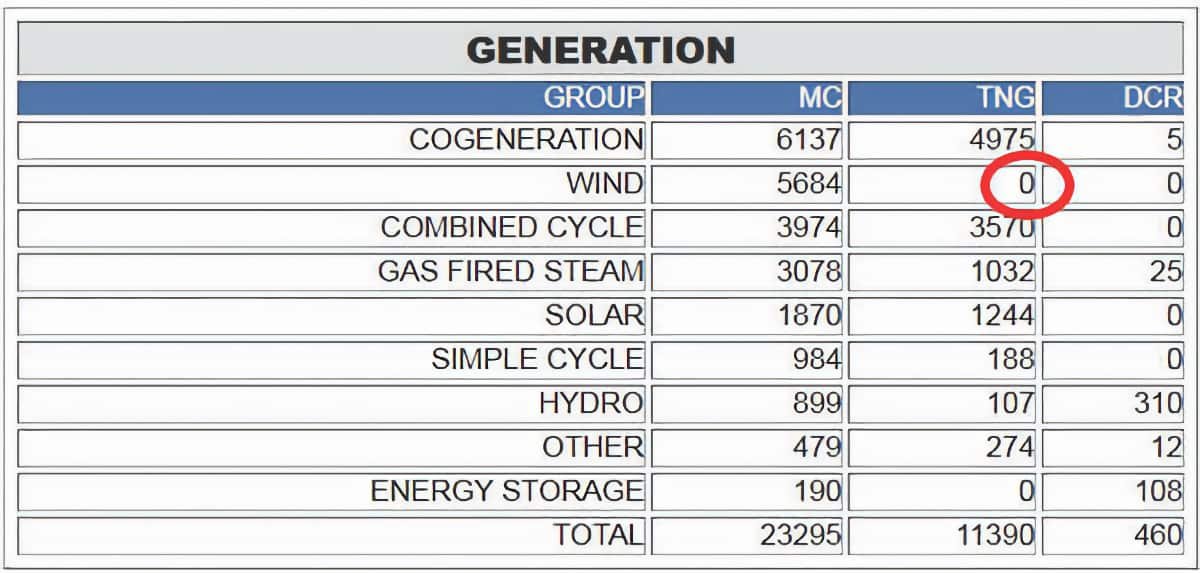
MC is maximum capacity, in megawatts. TNG is total net to grid. DCR is dispatched, and accepted, contingency reserve. This was at 9:51 a.m. on Saturday, Feb. 21, 2026. AESO
According to weather website Windy.com, temperatures at 10 a.m. were in the -17 to -18c range across southern Alberta, where the 50 wind farms are situated. That’s significant, because most wind turbines must shut down when it gets colder than -30 lest cold brittle behaviour of materials cause their equipment to shatter. They weren’t at zero output because of cold weather, but because there was simply no wind.
And indeed, that’s what Windy.com showed. Wind velocities in the wind turbine fairway included 1 knot at Pincher Creek, 2 knots at Fort McLeod, Vulcan and Bow Island.
The area Alberta’s 50 wind farms are dispersed across is larger than Belgium, Netherlands and Luxemburg combined.
At 8:04 a.m. and again at 9:51 a.m. wind output fell to zero. It may have done that at other times over the previous 27 hours, but Pipeline Online was able to observe those moments following the AESO data.
Wind remained at 0 megawatts output for 52 minutes, from 9:51 to 10:43 a.m. It again fell to zero after that point, showing zero at 11:05 a.m., but at some point this story needed to be published.
Just for comparison, a human can only survive about seven minutes without oxygen. So if hospital ventilators in Alberta had depended solely on wind output to keep their patients alive, each and every person on such ventilators would have expired.
Pipeline Online receives email alerts whenever Alberta’s wind generation falls below 10 megawatts. If the output stays below that threshold, another alert is not issued until output rises above that number and then falls below it again. Correcting for the time shift between Alberta and Saskatchewan, email alerts were received on Friday, Feb. 20 at 1 p.m., 2 p.m., 7:40 p.m., 7:50 p.m., 8:05 p.m., followed by 12:05 a.m., 4:06 a.m., 5:30 a.m., 5:45 a.m. 6:45 a.m., 8:55 a.m. and 10:55 a.m., the time this story was posted.
X account @ReliableAB posts hourly logs of AESO data on this site, and every two hours on X here.
Going back through those logs show wind at 103 megawatts, or 1.8 per cent capacity, at 6:59 a.m. on Friday, Feb 20. That was the highest hourly number logged for more than 27 hours. It fell to 52 megawatts, or 0.9 per cent output, an hour later at 7:59 a.m. It remained below 1 per cent output for the rest of the day and into Saturday. By 12:59 p.m. output started hitting single digits, and then bounced as high as 21 before coming down again.
At 2:59 a.m. and 3:59 a.m. on Saturday, Feb. 21, there was no data recorded for wind, indicating zero output at that time. How long it stayed at zero is not recorded.
Remarkably during this time, the AESO pool price for power did not spike to the stratosphere as would often happen in cases of low wind output. At 8 p.m. on Friday, the price peaked at $101 per megawatt-hour. And when it was bottomed out at zero on Saturday morning, the price was just $32.22 per megawatt-hour. SaskPower was exporting various amounts of power to Alberta during this time.
Original article can be found at www.pipelineonline.ca - used with permission.